
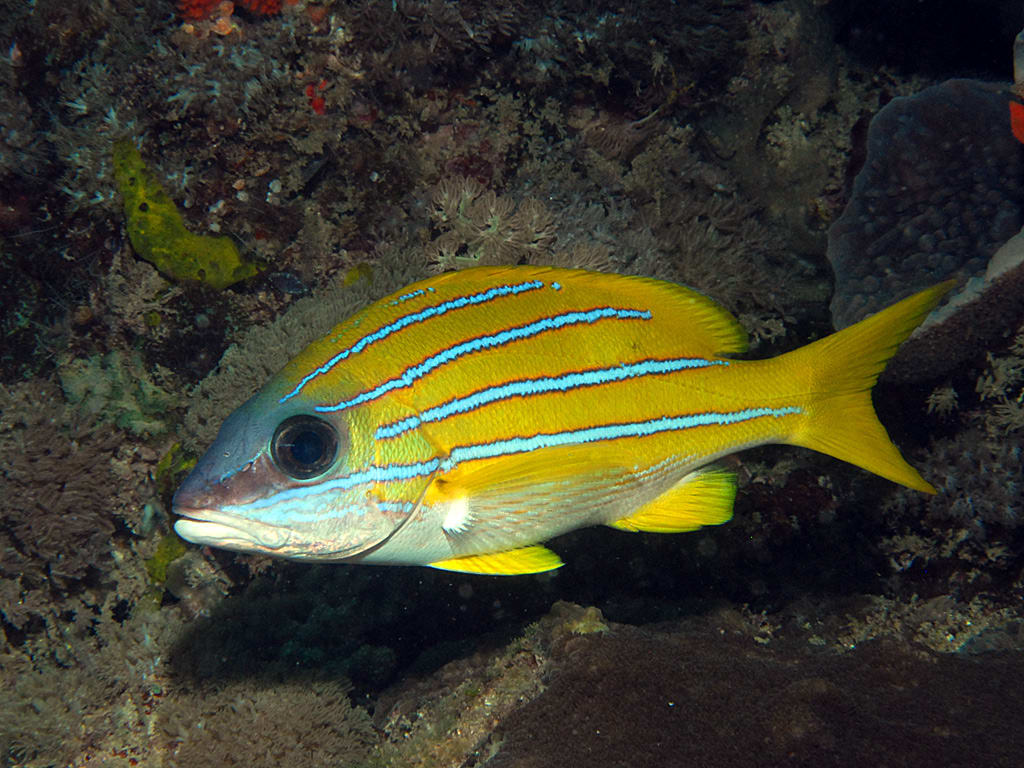
Taxonomy
- Kingdom
- Animalia
- Phylum
- Chordata
- Class
- Actinopterygii
- Order
- Perciformes
- Family
- Lutjanidae
- Genus
- Lutjanus
- Species
- kasmira
Habitat
The common blueline snapper primarily inhabits coral reefs, lagoons, and rocky areas in tropical marine environments. It prefers depths from 10 to 200 meters, often around structures that provide shelter and food. Geographically, it is found in the Indo-Pacific region, including areas like Hawaii, Australia, and the Indian Ocean.
Diet
The common blueline snapper feeds mainly on small fish, shrimps, crabs, and other benthic invertebrates. It hunts in schools or individually, typically during daylight hours when visibility is high. Feeding occurs near the ocean floor, where it picks prey from the substrate or chases smaller fish.
Behavior
The common blueline snapper is a schooling species that forms loose groups over reefs for protection and feeding. It is diurnal, active during the day and resting at night, with territorial behavior around prime feeding areas. Notably, it can change color slightly to blend with its surroundings or during mating.
Fishing
Targeting the common blueline snapper (Lutjanus kasmira) is a rewarding pursuit for anglers in the Indo-Pacific region, including hotspots like Hawaii, Australia, and the Indian Ocean, where it inhabits coral reefs, lagoons, and rocky structures at depths of 10 to 200 meters—focus on areas with cover for shelter and feeding. Use bottom fishing or jigging techniques for the best results, casting near reefs during the day when these schooling fish are most active and feeding on small fish, shrimps, and crabs; employ light to medium tackle with 10-20 lb test line, a sensitive rod for detecting bites, and hooks sized 1/0 to 2/0. Opt for live bait like shrimp or small fish, or effective lures such as jigs and soft plastics that mimic their natural prey. The prime season runs from warmer months like summer through fall, with early morning or late afternoon offering the highest activity for strikes. Record sizes include adults up to 40 cm and weights around 1 lb. 4 oz, with the IGFA all-tackle world record at 2 pounds 2 ounces, caught in Hawaii in 2005—showcasing the thrill of this sport fish. Angler-funded programs, including license fees, support habitat protection and stocking initiatives that maintain healthy snapper populations, while regulations like slot limits and bag restrictions in places like Hawaii serve as effective management tools to ensure sustainable fishing and conservation, promoting catch-and-release for undersized fish to bolster aquatic ecosystems.
Conservation Status
Listed as Least Concern by IUCN.