
Overview
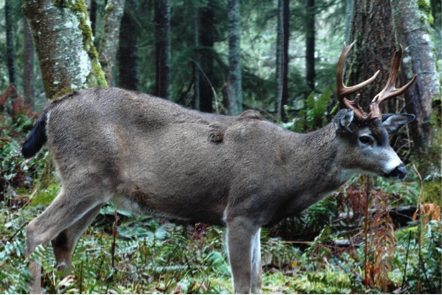
A black-tailed deer can be distinguished from a mule deer by its tail, metatarsal glands, overall coloration, face and antlers. A black-tail's tail is nearly as long as a mule deer's but is much wider, which makes it larger in comparison to the body. It is solid black on top except for a slight white fringe near the bottom, and the underside is white. (By comparison, a mule deer tail is narrow at the middle, tapering wider at top and bottom, and normally is white with a black tip, though sometimes the upper part will be brown). The underside tail hairs are not erectile, and the tail is not used for signaling. Preorbital, tarsal, metatarsal and interdigital glands are present. The metatarsal glands on a black-tail are 2-1/2 to 3 inches (6.4 to 7.6 cm) in length and are located about halfway between hock and hoof. (On a mule deer, these glands are five inches [12.7 cm] long and closer to the hock.) The summer coat is similar to that of a mule deer, but the winter coat is redder-a cedar brown. The black-tail's face is noticeably shorter and darker than a mule deer's, and the ears are smaller. The antlers are small, compact and relatively stout for their length, as befits a deer living in thick forest. Black-tails from drier, more open California habitat tend to have longer, wider antlers. It is not unusual for black-tails to have the T-3 tine missing-that is, to have a single point in place of the rear fork. It is also common for the T-3 tine to be stronger than T-2, which is the reverse of normal configuration.
Taxonomy
- Kingdom
- Animalia
- Phylum
- Chordata
- Class
- Mammal
- Order
- Artiodactyla
- Family
- Cervidae
- Genus
- Odocoileus
- Species
- Odocoileus hemionus
Habitat
Dense coastal forest and westward-facing mountain forest, but also found in grassland, oak and chaparral. Distribution- The Pacific Coast region of North America from Bella Bella and Bella Coola, British Columbia, in the north, including Vancouver Island and other offshore islands, to Ragged Point, Monterey County, California, in the south. Has been introduced on the island of Kauai in Hawaii.
Diet
Black-tails are browsers that eat very little grass.
Behavior
Habits are similar to those of a mule deer. Black-tails living in low-lying forests without much snow will remain in one small area year-round. In mountain areas, they migrate the same as mule deer, spending summers in the high meadows and winters in sheltered valleys. Black-tails sometimes mingle with mule deer in summer range, but in fall will descend the western slopes while the mule deer descend the eastern slopes. Sense of smell is paramount, although hearing is excellent and vision is good. When disturbed, black-tails tend to lie low or sneak away quietly instead of bounding off like a mule deer.
Hunting
Their sense of hearing is excellent and vision is good making it an exciting species to pursue.
Conservation Status
Listed as Least Concern by IUCN. While these animals have a broad and relatively diverse range, there are threats to certain populations situated on islands and other areas.