
Overview
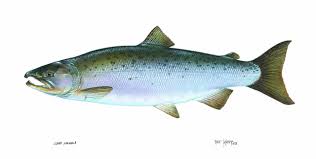
This is a silvery fish when at sea and has small black spots on the back, upper sides, base of the dorsal fin, and upper lobe of the tail. It can be distinguished from both the chinook salmon, Oncorhynchus tshawytscha, and the steelhead, or rainbow trout, O. mykiss, by the fact that it only has spots on the upper half of the tail while the latter two have spots over the entire tail. Also, it generally has pale or white gums and a black mouth (some Great Lakes specimens may have gray or black gums) while the chinook always has black gums and a black mouth.
Taxonomy
- Kingdom
- Animalia
- Phylum
- Chordata
- Class
- Actinopterygii
- Order
- Perciformes
- Family
- Salmonidae
- Genus
- Oncorhynchus
- Species
- kisutch
Habitat
Streams, Rivers, Oceans.
Diet
Insects, Plankton, Baitfish, Sand Lice, Herrings, Pilchards, Squid, Crustaceans, ect.
Behavior
Like all Pacific salmon, it does not feed once it enters freshwater on the spawning run. Although most coho do not seem to migrate extensively, tagged individuals have been recovered up to 1,200 mi from the tagging site. Some remain in freshwater lakes and streams, never venturing to sea. These specimens do not spawn and are replenished only by successive runs of migratory coho. An estimated 85 percent of native Pacific coho return to spawn in the same stream where they began their life.
Fishing
It is a very important commercial species and is marketed fresh, fresh frozen, mild cured, smoked, and canned. The usual commercial catch weighs about 6 12 lb (2 5 kg) with 20 lb (9 kg) not uncommon. They can reach weights of at least 33 lb (15 kg).
Conservation Status
Listed as Not Evaluated by IUCN.