
Overview
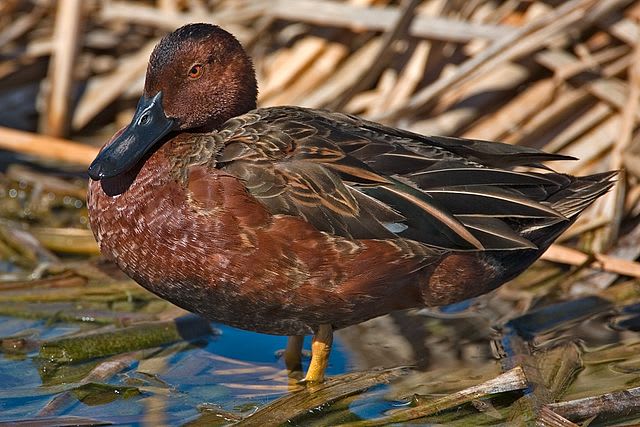
The Cinnamon Teal in North America is one of the most sought out duck species. These birds, being apart of the teal family, carry a small stature. The drake has an average length of 16 inches and the female around 15 inches. Their average weight ranges from .6 lbs. to .9 lbs.. The drake can be easily picked out from other ducks species. It has a cinnamon-red head, belly, breast, and neck. They have a distinct red eye and black bill along with yellowish colored feet. The drake gives off a “Peep” like most teal drakes and the hen makes a raspy laughing noise. The hen is identical with a Blue-Winged Teal hen by having a brownish coloration. Both drake and hen teal have a blue shoulder patch on wings. They can be found in small shallow waters with a lot of cover or tall grassy areas for nests. They feed mainly on rush seeds, insects, and pondweeds.
Taxonomy
- Kingdom
- Animalia
- Phylum
- Chordata
- Class
- Bird
- Family
- Anatidae
- Genus
- Anas
- Species
- cyanoptera
Habitat
These birds breed mainly in the western part of the United States. These birds migrate from The Great Salt Lake marshes to Mexico and Central America. They can be seen attached or flying with flocks of Blue-Winged teal in several areas of the United States. They feed mainly on rush seeds, insects, and pondweeds.
Diet
Cinnamon teal are surface feeders and prefer to feed on mud flats, in fields, or in shallow water where there is floating and shallowly submerged vegetation plus abundant small aquatic animal life. They mostly eat vegetative matter consisting of seeds or stems and leaves of sedge, grass, pondweed, smartweed (Polygonum spp.), duckweed (Lemna spp.), Widgeongrass, and muskgrass (Chara spp.). The seeds of plants that grow on mud flats, such as nutgrass (Cyperusspp.), smartweed, millet (Panicum spp.), and Rice Cut-grass (Leersia oryzoides), are avidly consumed by this duck. One-fourth of the food consumed by blue-winged teal is animal matter such as mollusks, crustaceans, and insects.
Behavior
Cinnamon teal generally select new mates each year. They are migratory and most winter in northern South America and the Caribbean, generally not migrating as far as the blue-winged teal. Some winter in California and southwestern Arizona.
Hunting
Typically hunted with a 12 ga shotgun. Shot size #2-4 is sufficient. Effectively hunted with decoys and calling. Dogs are used for bird retrieval. Steel shot is required for waterfowl in the United States.
Conservation Status
Listed as Least Concern by IUCN.