
Overview
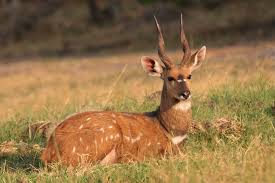
Subspecies specific description- A medium-sized Imbabala, reddish brown in color, with considerable local and individual variation in the pattern of spots and stripes. Some animals resemble Nile or even harnessed bushbucks in the extent of the harness pattern, while others are drab with few spots. Imbabala species- They have a light brown coat, with up to seven white stripes and white splotches on the sides. The white patches are usually geometrically shaped and on the most mobile parts of their body such as the ears, chin, tail, legs and neck. The muzzle is also white and horns are found only on the males and they can reach over half a metre with only one twist. At 10 months old, young males sprout horns that are particularly twisted and at maturity form the first loop of a spiral. Imbabala display a great range in coloration throughout their range and amongst subspecies.
Taxonomy
- Kingdom
- Animalia
- Phylum
- Chordata
- Class
- Mammal
- Order
- Artiodactyla
- Family
- Bovidae
- Genus
- Tragelaphus
- Species
- Tragelaphus sylvaticus
- Subspecies
- Tragelaphus sylvaticus
Habitat
Inhabits rain forests, montane forests, forest-savanna mosaics, bush savanna forest, scrub forest, grasslands, and woodlands.
Diet
Mainly browse, but supplement their diet with any other plant matter that they can reach.
Behavior
Active around 24 hours a day, but tend to be nocturnal near human habitations. They tend to be solitary, though some live in pairs. Imbabala live within a home area, which is usually around 50, 000 square metres (12.5 square miles) on the savannah and much larger in the forest, that they will not normally leave. These areas usually overlap other bushbuck home areas. Imbabala are basically solitary animals and the mature males go out of their way to stay away from each other. Usually, imbabala are most active during early morning and part of the night, therefore are almost entirely nocturnal in areas where they are unlikely to be disturbed.
Hunting
Many are taken as chance encounters while hunting other species. They are very secretive and wary, making them a very impressive game animal that is both beautiful and a challenge to hunt. They are sometimes hunted by being pushed out of thick cover or gulleys that they are expected to be within. This antelope should be treated with caution, especially if wounded. They are brave and those pointy little horns can sever your femoral artery with one sweep.
Conservation Status
Listed as Least Concern by IUCN. However, this assesment is based on this specie still being combined with the Harnessed bushbuck, and it does not recognize any subspecies and only applies to the Imbabala as a whole. Therefore, it is irrelavent to our database and how we have organized this specie. IUCN needs to better assess these newly recognized species individual of each other, and determine populations and assesments of subspecies.