
Overview
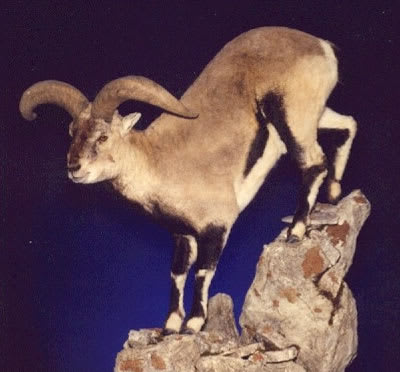
Compared with the Himalayan blue sheep, the body size is 10-20 percent smaller and the color is lighter, being a buffy-brown. Facial mask is a lighter brown, sides of face are whitish and sides of neck are light buff. There is less black on front of neck and chest, and the black lateral band is narrower and stops several inches behind the shoulder instead of almost joining the dark chest patch. The horn length and circumference are also 10-20 percent smaller than the Himalayan blue sheep, but the tip-to-tip measurement is usually much greater. Horns grow outward horizontally, with little downward curve, then turn backward with the tips inclined upward. In cross section they are rounded throughout their length, with only the frontal-nuchal edge sharply defined.
Taxonomy
- Kingdom
- Animalia
- Phylum
- Chordata
- Class
- Mammal
- Order
- Artiodactyla
- Family
- Bovidae
- Genus
- Psuedois
- Species
- Pseudois nayaur
Habitat
Found at very high altitudes. Distribution- Central China, where it is found in central and eastern Qinghai, western Sichuan, Gansu, southwestern Ningxia, and western and southern Inner Mongolia. Boundaries with the Tibetan blue sheep to the west are unclear.
Diet
Primarily consumes grasses but will browse when necessary.
Behavior
Chinese blue sheep are active throughout the day, alternating between feeding and resting on the grassy mountain slopes. Due to their excellent camouflage and the absence of cover in their environment, Chinese blue sheep remain motionless when approached. Once they have been noticed, however, they retreat up cliffs, where they once again freeze, using camouflage to blend in.
Hunting
Chinese blue sheep are usually hunted at higher altitudes than any other game animal. This is especially true in early autumn before there is snow to drive them down to lower elevations. At this time of year they can be at 16,000-17,000 feet (5,200-5,600 m) or even higher.
Conservation Status
Listed as Least Concern by the IUCN.