
Overview
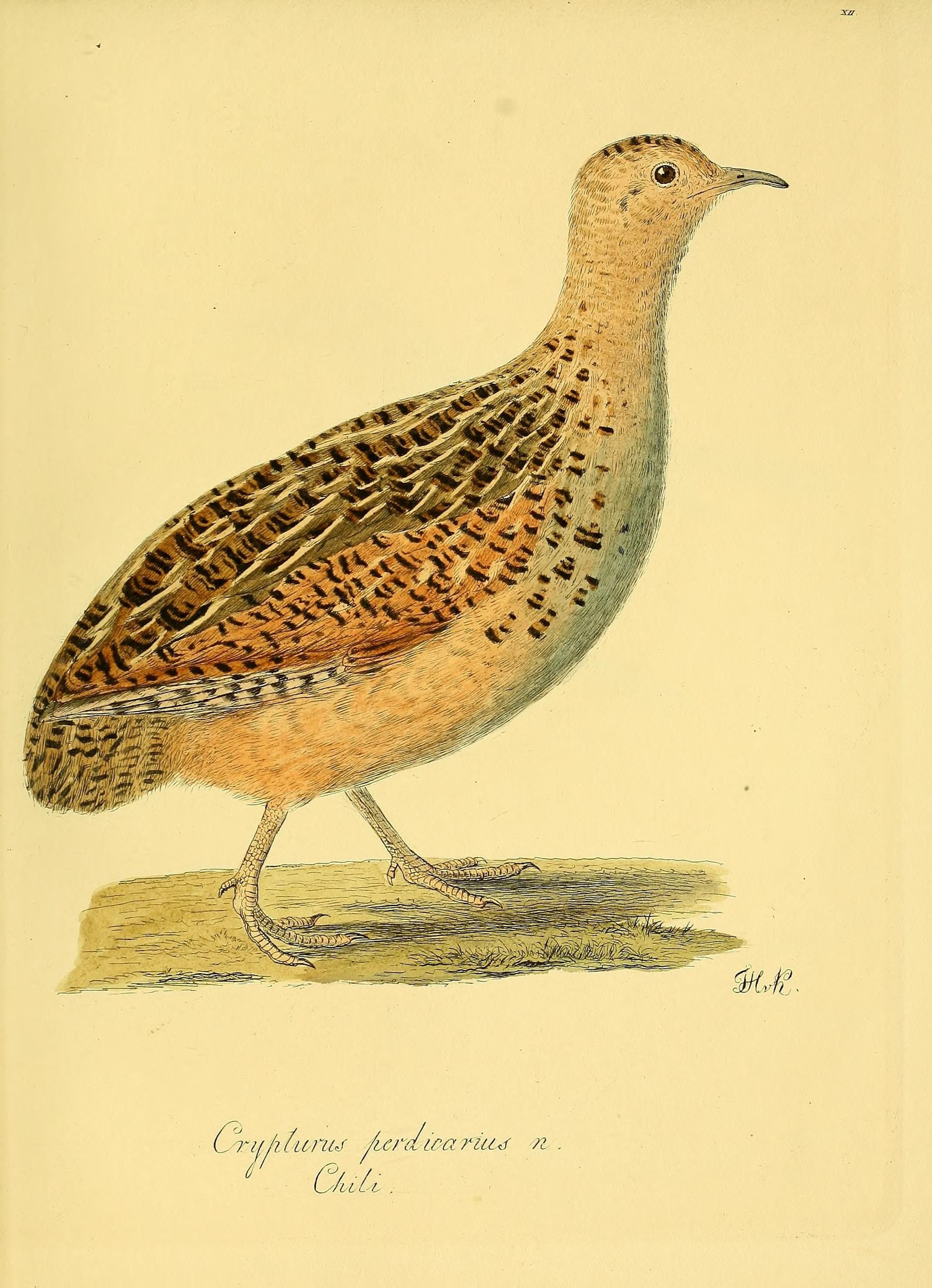
The Chilean tinamou is almost tail-less and is stocky in shape. It has a bill that is curved and similar to the California quail. It has thick, short, pale, yellowish legs. It generally walks upright and has short tail and tail coverts drooping behind legs. The pattern on its upper body looks striped, but is more complex in detail. It has a buffy face with a dark eyeline that is drooping and a small strip on its cheek, with a lighter colored crown. Its neck is brown and its lower neck has dark spots. It has a complex patterns that streak on the side of the chest, which is grey. The Chilean tinamou, just south of the Maule Region, has a brownish chest instead of a grey chest and more and reddish brown stripes on its upperbody and buttocks. For both regions, it has large wings that cover the body when on ground, and when flying the wings appear large and reddish brown underneath. The wings are also rounded.
Taxonomy
- Kingdom
- Animalia
- Phylum
- Chordata
- Class
- Bird
- Family
- Tinamidae
- Genus
- Nothoprocta
- Species
- perdicaria
Habitat
This tinamou can also be found in arid mountain forests in association with such trees as Acacia caven, Porlieria chilensis and the endangered Jubaea chilensis.
Diet
The diet, during the winter, consists mainly of seeds, leaves, fruit and insects, but in the summer it eats mainly insects.
Behavior
The females lay 10-12 glossy eggs in a scrape. The male incubates the eggs and raises the chicks. The eggs are covered with feathers when left unattended. Incubation is around 21 days. The chicks are buff with dark stripes, and run soon after hatching and fly when half-grown. Later in life blue or gray spots may appear.
Hunting
Hunted in heavy cover, typically with pointing dogs. Birds are flushed and taken with shotguns. A 20ga with 6 shot will be sufficient.
Conservation Status
Listed as Least Concern by IUCN.