
Overview
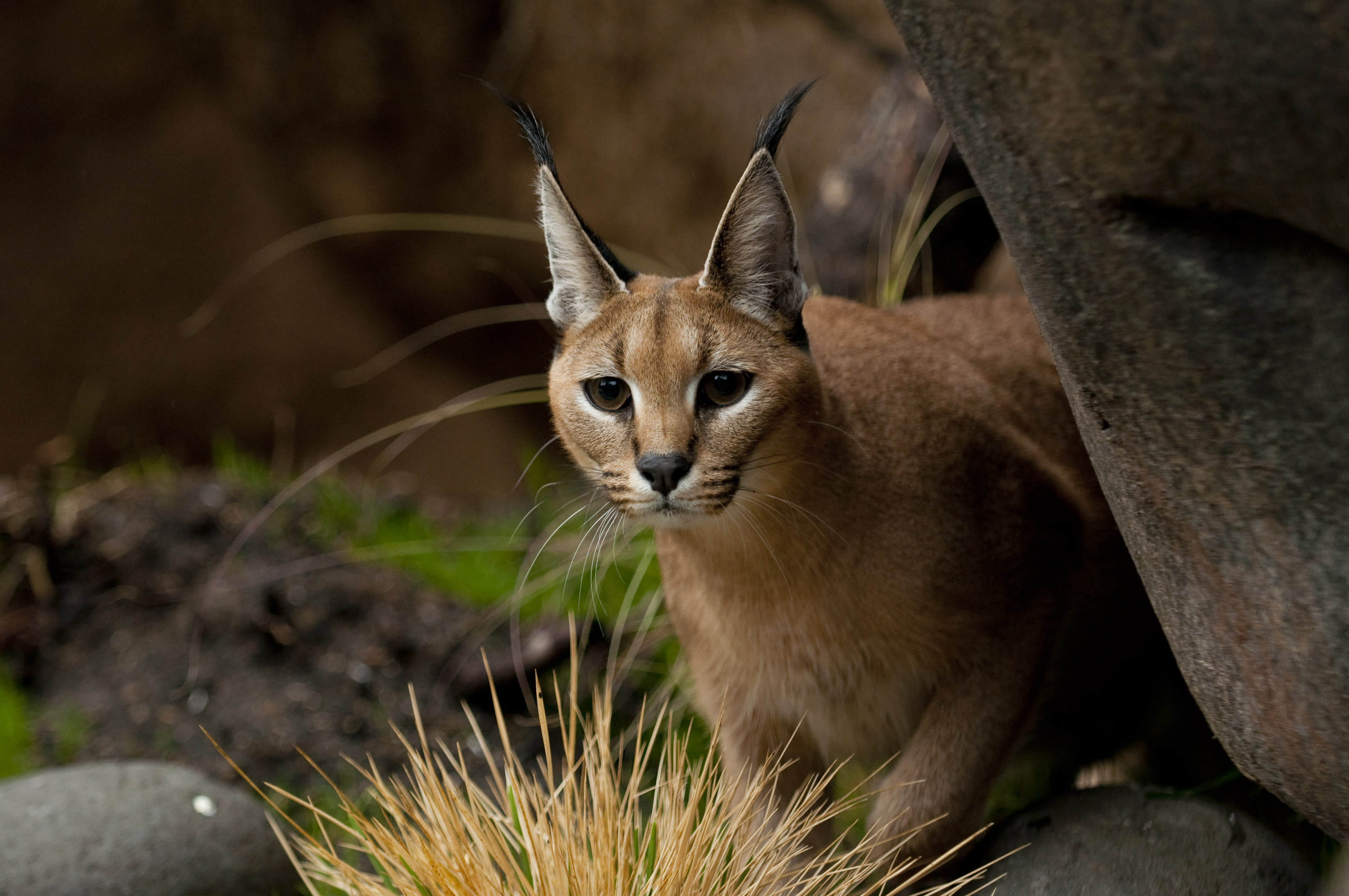
The caracal is the largest of the small African cats. It has a long, slender, uniformly colored body with a comparatively short, tapering tail and long, tufted ears. The short, thick coat varies from grayish to reddish-brown, with white on chin, throat and underparts, and a black line from eye to nose. Coloration tends to be lighter in arid regions and darker where there is more rain. Black (melanistic) individuals are occasionally seen. The hind legs are longer than the forelegs, so that the animal appears to be tilted forward. The caracal's ears are its most distinctive feature, being long, narrow and pointed, black on the outside, and topped with 1-3/4 inch (45 mm) tufts of black hair.
Taxonomy
- Kingdom
- Animalia
- Phylum
- Chordata
- Class
- Mammal
- Order
- Carnivora
- Family
- Felidae
- Genus
- Caracal
Habitat
Mainly dry savanna, scrub and woodland. Not found in true desert or rain forest. Found as high as 8,000-10,000 feet (2,500-3,000 m) in the mountains of Ethiopia. Distribution- Most of Africa except for the central Sahara and the tropical rain forests of West Africa, the Congo Basin, and Natal. Outside of Africa, the caracal is found in southwestern Asia from the Middle East to northwestern India.
Diet
Feeds mainly on birds, hares, rodents, hyraxes, monkeys and small antelopes. Able to take prey as large as impala, springbok and young greater kudu. Kills domestic livestock in some areas. Feeds on carrion at times. Able to go without water for days by obtaining moisture from its prey.
Behavior
Solitary and reportedly territorial. Breeding probably occurs year-round, with 1-4 young born after about 79 days gestation. Cubs stay with the mother for about a year. Females are sexually mature at 14-16 months and are believed to have one litter a year. Largely nocturnal, but also is seen during daytime. The caracal is a fast runner-the swiftest of the smaller African cats-a good tree climber and an exceptional jumper, leaping high in the air to knock down birds. The caracal is easily tamed, and has been trained to hunt for its human owners in Iran and India.
Hunting
Hunting the caracal is more often than not a chance encounter. A spotlight at night over bait can sometimes be effective. You will probably have to shoot from a blind and be extremely still and quiet. Predator calls can also be employed and can be an effective method to getting this wary feline to show himself. While not legal everywhere, the caracal can be hunted with dogs in the Eastern Cape.
Conservation Status
Listed as Least Concern by IUCN, although there is significant variation across this animal's range. Due to its large geographical distribution covering a wide range of environments, Caracal is subject to different pressures and threats that vary in extent and severity resulting in very different local population trends. While the species is considered as Least Concerned in Arabian Peninsula (Mallon and Budd 2011), it is listed as Endangered in Jordan (GCEP 2000), Critically Endangered in Pakistan (Sheikh and Molur 2004) and Morocco (Cuzin 2003). It is already vanished in Kuwait (Cowan 2013), parts of Turkmenistan (Lukarevsky 2001) and believed to be on the verge of extinction in many parts of North Africa (Cuzin 2003, F. Belbachir, pers. comm. 2014). However, while it shows such signs of population declines and range loss in parts of Asia and Northern Africa, Caracal is very common and stable in central and southern Africa (Thorn et al. 2011) which covers a large fraction of its global range. Because the declines are highly local and none cause a significant range loss in relation to its global population, the species is considered as Least Concern. (IUCN)
Subspecies (8)
- West African caracalCaracal caracal poecilotis
- Gabon caracalCaracal caracal lucani
- Asiatic caracalCaracal caracal schmitzi
- Common caracalCaracal caracal caracal
- Namibian caracalCaracal caracal damarensis
- Northern African caracalCaracal caracal algira
- Nubian caracalCaracal caracal nubica
- Transvaal caracalCaracal caracal limpopoensis