
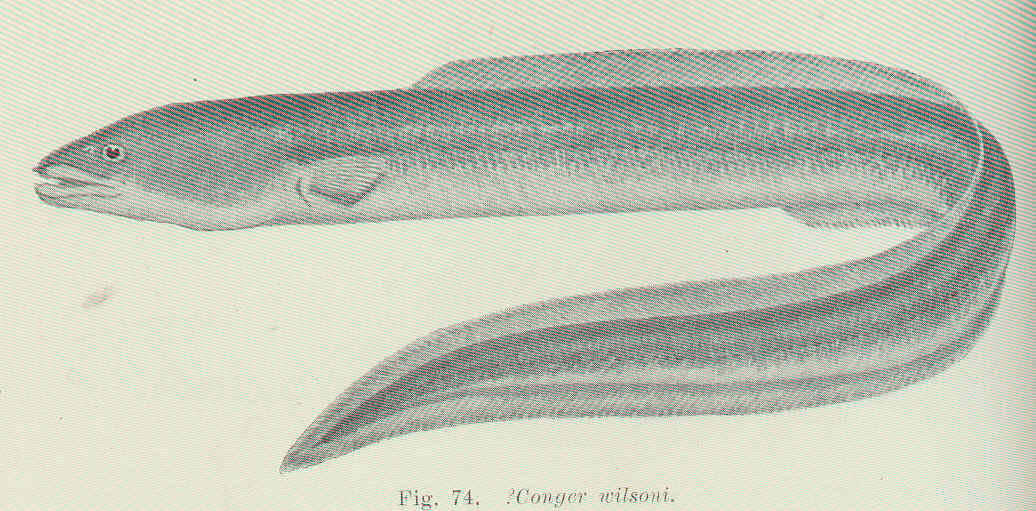
Taxonomy
- Kingdom
- Animalia
- Phylum
- Chordata
- Class
- Actinopterygii
- Order
- Hiodontiformes
- Family
- Congridae
- Genus
- Conger
- Species
- wilsoni
Habitat
Cape congers inhabit coastal marine waters, often around rocky reefs, sandy bottoms, and coral structures in the Indian and Western Pacific Oceans. They prefer depths from shallow coastal areas to about 200 meters, and are commonly found in regions like Australia, New Zealand, and the Maldives. This species avoids freshwater and thrives in temperate to tropical seas.
Diet
Cape congers primarily feed on small fish, squid, and crustaceans, using their sharp teeth to capture prey in ambush attacks. They are nocturnal hunters, actively foraging at night in deeper waters or near the seafloor. Feeding behavior includes hiding in crevices during the day and emerging to strike quickly at passing prey.
Behavior
Cape congers are solitary and territorial, often hiding in rock crevices or burrows during the day and becoming active hunters at night. They exhibit aggressive behavior when threatened or competing for food, and are known to migrate seasonally to deeper waters for spawning. This species is generally elusive and avoids open areas, relying on camouflage for protection.
Fishing
Target the Cape conger, a powerful eel species found in the coastal waters of the Indian and Western Pacific Oceans, including Australia, New Zealand, and the Maldives, for an exciting recreational fishing experience that supports marine conservation through angler-funded programs like license fees and habitat restoration. Use bottom fishing techniques with strong, heavy tackle to handle their elusive, ambush-style behavior, employing a sturdy rod and reel combo with 20-50 lb test line, circle hooks, and a solid leader to withstand their sharp teeth and powerful runs—cast near rocky reefs, sandy bottoms, or coral structures in depths from shallow coasts to 200 meters. Opt for bait like live small fish, squid, or crustaceans to mimic their natural diet, or try lures such as soft plastics and jigs for effective strikes. The best seasons are during warmer months for increased activity, with prime fishing times at night when they hunt actively; focus on tidal movements around dusk for higher success. Record sizes reach up to 7 pounds 7 ounces, showcasing the thrill of landing these fighters, though specific IGFA records are not established—always check local regulations to ensure sustainable practices. As a species listed as Not Evaluated by the IUCN, conservation efforts benefit from catch-and-release methods and slot limits in managed areas, which help maintain healthy populations and protect these temperate to tropical waterways through angler participation in stocking and monitoring programs.
Conservation Status
Listed as Not Evaluated by IUCN.