
Overview
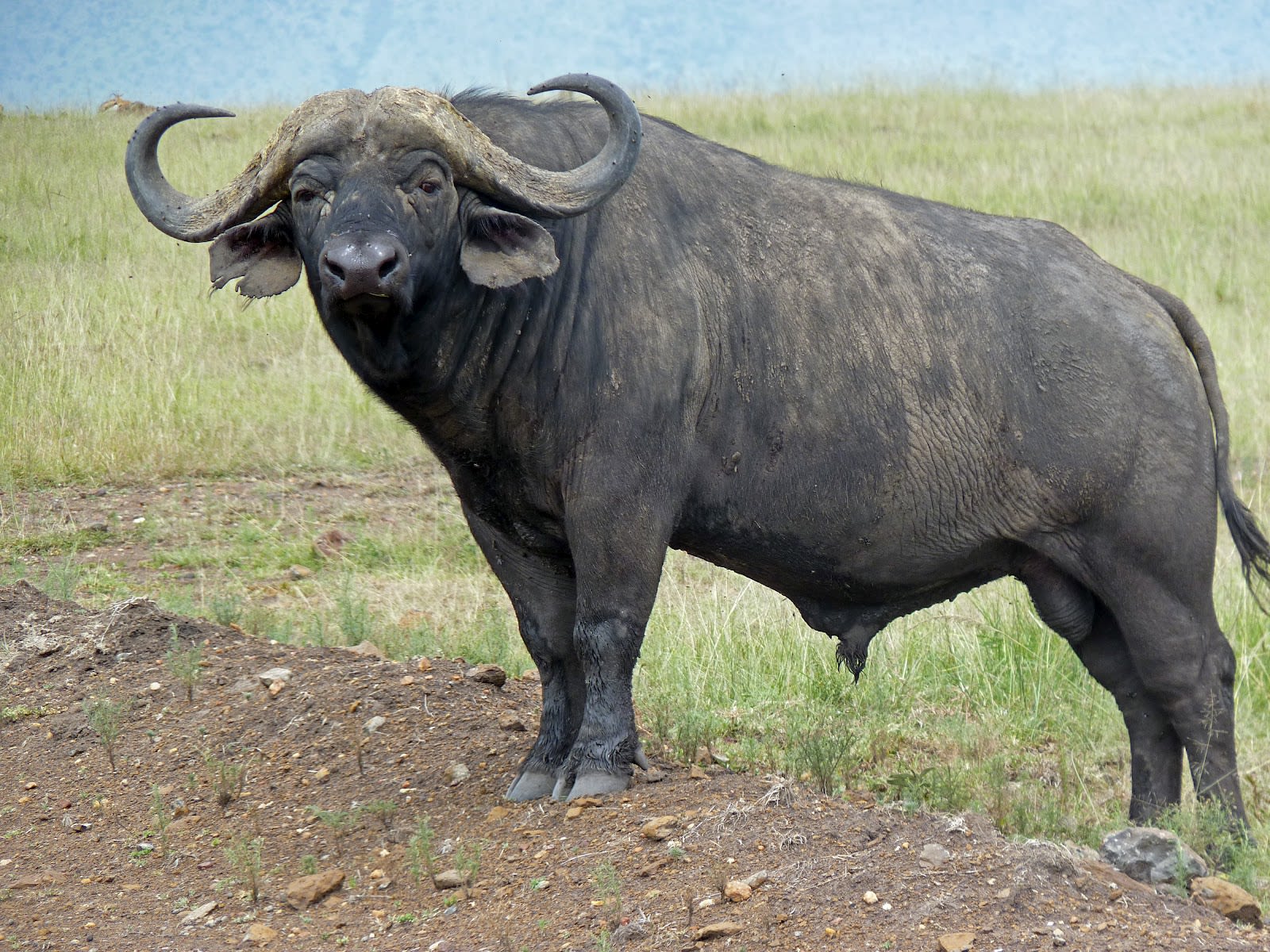
The largest and darkest (black, or nearly so) of the African buffaloes. Its heavy horns curve outward and downward from massive bosses to well below skull level, then circle upward, inward and slightly backward.
Taxonomy
- Kingdom
- Animalia
- Phylum
- Chordata
- Class
- Mammal
- Order
- Artiodactyla
- Family
- Bovidae
- Genus
- Syncerus
- Species
- Syncerus caffer
Habitat
Swamps and floodplains, as well as mopane grasslands and forests of the major mountains of Africa. This buffalo prefers habitat with dense cover, such as reeds and thickets, but can also be found in open woodland. While not particularly demanding with regard to habitat, they require water daily, so they depend on perennial sources of water. Distribution- Savanna areas in Kenya, southern Somalia, Uganda except in the northwest, Rwanda, Burundi and Tanzania; all of Angola except for the far northwest; Katanga Province in southeastern Congo (K); Zambia, Malawi, Mozambique, the Caprivi Strip in Namibia, northern Botswana, Zimbabwe, and northeastern Transvaal in South Africa. Has been reintroduced on private ranches in other parts of South Africa.
Diet
One of the most successful grazers in Africa. Like the plains zebra, the buffalo can live on tall, coarse grasses. Herds of buffalo mow down grasses and make way for more selective grazers. When feeding, the buffalo makes use of its tongue and wide incisor row to eat grass more quickly than most other African herbivores. They do not stay on trampled or depleted areas for long.
Behavior
Their herd size is highly variable with the core being females and their offspring. Bachelor groups of older mature males will stick together and are known as Dugga Boys. African buffaloes are notable for their apparent altruism. Females appear to exhibit some sort of voting behavior. During resting time, the females will stand up, shuffle around, and sit back down again. They will sit in the direction they think they should move. After an hour of more shuffling, the females will travel in the direction they decide. This decision is communal and not based on hierarchy or dominance. When chased by predators, a herd will stick close together and make it hard for the predators to pick off one member. Calves are gathered in the middle. A buffalo herd will respond to the distress call of a captured member and try to rescue it. A calf's distress call will get the attention of not only the mother, but also the herd. Buffaloes will engage in mobbing behavior when fighting off predators. The African Lion is the buffaloes mortal enemy as African Lions are capable of preying on buffalo all while buffalo often times kill African Lions in defense. Buffaloes mate and give birth only during the rainy seasons. Birth peak takes place early in the season, while mating peaks later. A bull will closely guard a cow that comes into heat, while keeping other bulls at bay.This is difficult, as cows are quite evasive and attract many males to the scene. By the time a cow is in full estrus, only the most dominant bull in the herd/subherd is there.
Hunting
A member of the Big 5. The Cape Buffalo is known as one of the most dangerous animals in the world to hunt.
Conservation Status
The current status of African Cape buffalo is dependent on the animal's value to both trophy hunters and tourists, paving the way for conservation efforts through anti-poaching patrols, village crop damage payouts, and CAMPFIRE payback programs to local areas. The buffalo is listed as Least Concern by the IUCN as the species remains widespread, with a global population estimated at nearly 900,000 animals, of which more than three-quarters are in protected areas. While some populations (subspecies) are decreasing, others will remain unchanged in the long term if large, healthy populations continue to persist in a substantial number of national parks, equivalent reserves and hunting zones in southern and eastern Africa.