
Overview
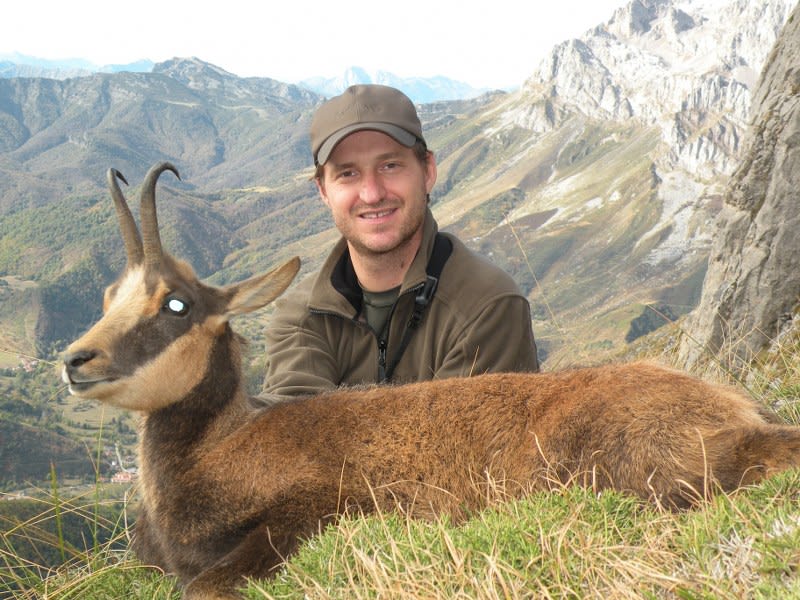
The lightest coloration of the chamois subspecies. Coat is reddish in the summer and brown in the winter. Underparts are pale. Rump, throat, lower jaw and front of face are yellowish. Paler in color than the Pyrenean chamois. Both sexes grow short, slim black horns that are round in cross section and hook sharply backward near the tips. The female's horns can be longer than the male's, but are slimmer and sometimes lack the hooks.
Taxonomy
- Kingdom
- Animalia
- Phylum
- Chordata
- Class
- Mammal
- Order
- Artiodactyla
- Family
- Bovidae
- Genus
- Rupicapra
- Species
- Rupicapra pyrenaica
Habitat
Forest and alpine meadows, with nearby cliffs utilized to escape predators. Distribution- Cantabrian Mountains of northwestern Spain.
Diet
Grasses year-round with an increase in the proportion of dwarf shrubs in winter.
Behavior
Primarily diurnal in activity, they often rest around mid-day and may actively forage during moonlit nights. Female chamois and their young live in herds of up to 100 individuals; adult males tend to live solitary for most of the year. During the rut (late November/early December in Europe, May in New Zealand), males engage in fierce battles for the attention of unmated females. The kid is weaned at six months of age and is fully grown by one year of age. However, the kids do not reach sexual maturity until they are three to four years old, although some females may mate at as early two years old. At sexual maturity, young males are forced out of their mother's herds by dominant males (who sometimes kill them), and then wander somewhat nomadically until they can establish themselves as mature breeding specimens at eight to nine years of age.
Hunting
It is best to hunt chamois from above, as their natural instinct is to scan for danger from below.
Conservation Status
Stable, with numbers estimated at 15,000 in 1981 and 17,000 in 2008.