
Overview
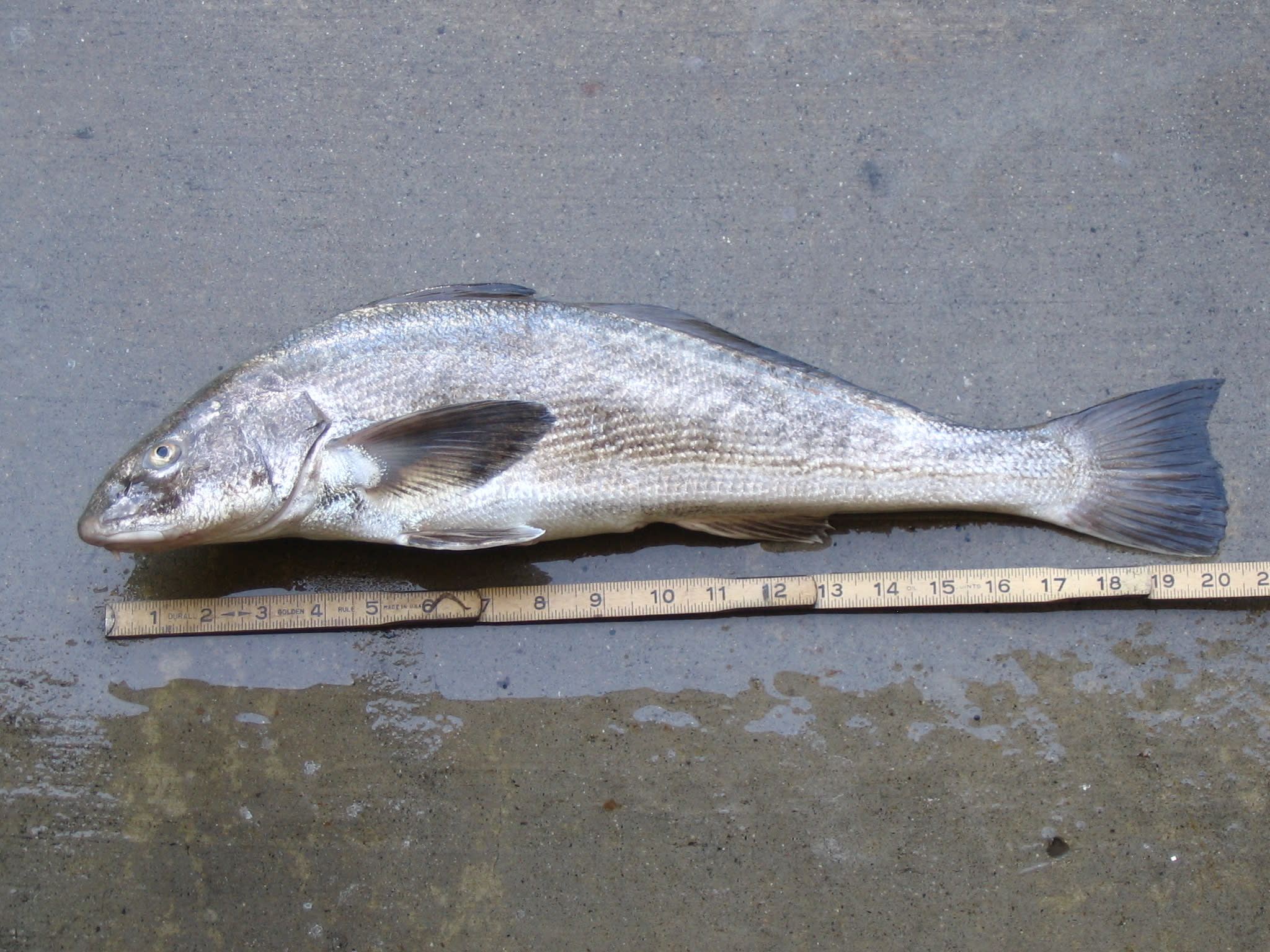
Unlike most drums and croakers, the California corbina has no air bladder and is unable to make croaking sounds. The California corbina body is elongate and more slender than other croakers. The head is long and the mouth small with a blunt snout projecting beyond the mouth. The color is gray to steel blue with a silvery luster on the back paling to white below. Sometimes wavy diagonal lines are on the sides. The California corbina and the yellowfin croaker are the only two coastal croakers in California water to have a single short, stiff chin barbel. The California corbina usually has only one weak spine at the front of the anal fin, while the yellowfin croaker has two strong spines.
Taxonomy
- Kingdom
- Animalia
- Phylum
- Chordata
- Class
- Actinopterygii
- Order
- Perciformes
- Family
- Sciaenidae
- Genus
- Menticirrhus
- Species
- undulatus
Habitat
This eastern Pacific species is found from Point Conception in California to Peru. It occurs along sandy shores and in bays, usually in sandy surfs of exposed outer coast. They are usually found in small groups with larger fish becoming more solitary.
Diet
California corbina primarily feed on small crustaceans, polychaete worms, and bivalve mollusks found in sandy substrates. They use their chin barbel to detect and excavate prey from the sand. Feeding activity peaks during daylight hours in shallow coastal waters.
Behavior
California corbina are often found in small schools, particularly juveniles, but larger individuals tend to be more solitary. They are diurnal, actively foraging during the day and burrowing into the sand to evade predators. These fish exhibit skittish behavior when approached, quickly darting away in shallow waters.
Fishing
California corbina are caught throughout the year although the best fishing is from July to October. They are very wary and difficult to hook as many an avid surf fisherman can affirm. Sand crabs are the preferred bait, though some anglers swear by blood worms, mussels, clams, pileworms, and ghost shrimp.
Conservation Status
Listed as Data Deficient by IUCN.