
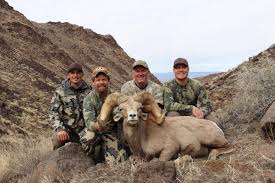
Overview
It is considerably smaller than the Rocky Mountain bighorn in body and horn size. The horns are shorter and tend to have more flare. The ears are longer, the coat is not as heavy, and the color is lighter, being more gray than brown. Normally a dark stripe extends from the dorsal area through the white rump patch to connect with the dark tail, whereas in the Rocky Mountain bighorn this stripe is usually interrupted or absent. Desert bighorns are also smaller than Stone sheep, Dall sheep, and Siberian snow sheep.
Taxonomy
- Kingdom
- Animalia
- Phylum
- Chordata
- Class
- Mammal
- Order
- Artiodactyla
- Family
- Bovidae
- Genus
- Ovis
- Species
- Bighorn sheep, canadensis
Habitat
Less steep habitats with more grassy areas than that of the Rocky Mountain bighorn.
Diet
Bighorn sheep feed on grasses in the summer and browse shrubs in the fall and winter, and compared to the California Bighorn, consumes more browse and less grass. They seek minerals at natural salt licks to add nutrients to their diet.
Behavior
These animals have wide-set eyes that provide a large angle of vision, as well as sharp hearing and a highly developed sense of smell, allowing Bighorns to detect dangers at great distances. The sexes remain separate except during the breeding season. Lambs are born in the spring, walk soon after birth, and nurse for six months. Rams will determine their hierarchy at the start of the breeding season, and males may ram each other headfirst at speeds up to 40 mph (64 kmh). This act is repeated until one animal concedes. Bighorn sheep skulls are thick and bony to absorb this repeated impact and prevent injury to the ram.
Hunting
All California bighorn entries must show the name and number of the game management unit in the province or state where they were taken. Many populations are the result of introductions and/or transplants, but we treat them as indigenous for record-keeping purposes.
Conservation Status
Populations are secure but not considered plentiful. They are under constant pressure from loss of habitat, competition from domestic livestock, and diseases transmitted by domestic sheep. There are at least 51 species of parasites known to affect bighorn sheep, 36 of which are carried by domestic sheep and 18 by cattle. Bighorns are particularly vulnerable to pneumonia brought on by lungworm infection, and catastrophic die-offs have sometimes occured. The IUCN status (2002) of Ovis canadensis (all subspecies) is listed as low risk/conservation dependent. Bighorn sheep subspecies in North America were estimated at 1.5 to 2 million during the pre-Columbian periods (Seton 1929). By 1960, the population of bighorn sheep in North America dropped to 15,000-18,000 (Buchner 1960), and the total desert bighorn sheep population was estimated at 7,065-8,475 (Buchner 1960). However, due to conservation by government and non-government groups, the 1993 overall desert bighorn sheep population increased to 18,965-19,040. The endangered peninsular bighorn sheep, a population of desert bighorn sheep, was estimated at 780-1,170 in Baja California, Mexico in 1993. Census from Sharkleton in 1997 had Ovis canadensis canadensis at = 36,700; O. c. californiana at 8,900; O. c. nelsoni at 15,000; O. c. Mexicana greater than 2,000; O. c. cremnobates at less than 2,500 and O. c. weemsi at 500. Ovis canadensis cremnobates IUCN status = endangered. Listed as endangered in 1998 by U.S.F.W.S. The latest population estimate (excluding lambs) was 334 (Rubin 1998).