
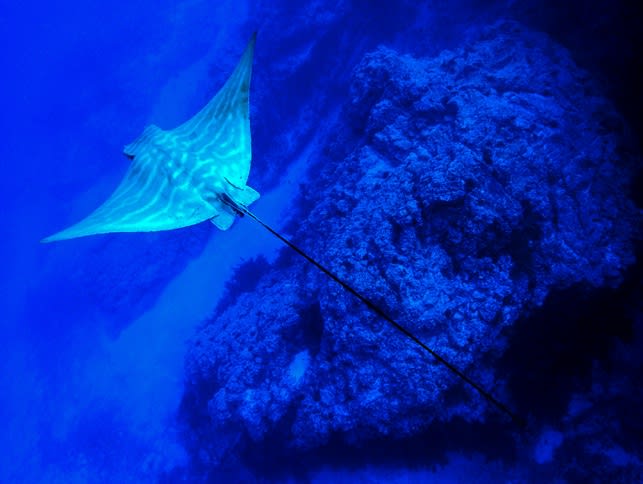
Taxonomy
- Kingdom
- Animalia
- Phylum
- Chordata
- Class
- Chondrichthyes
- Order
- Carcharhiniformes
- Family
- Aetobatidae
- Genus
- Pteromylaeus
- Species
- bovinus
Habitat
Bull rays prefer coastal waters, including bays, estuaries, and continental shelves, often over sandy or muddy substrates. They are commonly found in the eastern Atlantic Ocean, Mediterranean Sea, and western Indian Ocean, inhabiting depths from shallow intertidal zones to about 50 meters.
Diet
Bull rays primarily consume bottom-dwelling invertebrates such as crabs, shrimp, and mollusks, using their powerful jaws to crush shells. They forage by gliding along the seafloor and stirring up sediment to uncover prey, typically feeding during daylight hours.
Behavior
Bull rays are mostly solitary but may form loose groups during migration or feeding. They are diurnal, actively swimming and hunting during the day while resting on the bottom at night, and can exhibit territorial behavior around favored feeding spots. These rays often bury themselves in sand to ambush prey or evade threats.
Fishing
Bull rays provide thrilling sport fishing opportunities in coastal waters of the Atlantic, Mediterranean, and Indian Oceans, serving as a key species for recreational anglers who support conservation through license fees and habitat programs. Use bottom fishing techniques with heavy tackle to handle their powerful runs, including a stout rod (8-12 feet), a high-capacity reel spooled with 50-80 lb braided line, and strong circle hooks (5/0 to 10/0) to promote safe catch-and-release. Opt for bait like live crabs, shrimp, or cut fish to imitate their diet of bottom invertebrates, as these rays are often drawn to stirred-up sediment. The best seasons are spring and summer during daylight hours when they are most active for feeding and mating, making early morning or late afternoon ideal. Target them in bays, estuaries, and continental shelves over sandy or muddy substrates at depths up to 50 meters, focusing on areas like Senegal, Cape Verde, or the Mediterranean where they bury themselves in the sand. The largest recorded bull ray weighed 103 pounds 11 ounces, with IGFA records highlighting impressive catches that underscore the species' strength; always adhere to local slot limits or catch-and-release regulations as effective management tools that sustain populations, especially since bull rays are listed as Data Deficient by the IUCN, benefiting from angler-supported initiatives that protect these vital marine habitats.
Conservation Status
Listed as Data Deficient by IUCN.