
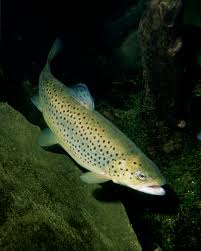
Overview
It resembles its relative, the Atlantic salmon (Salmo salar). Despite the historical common names “salmon” and “trout”, these two species belong to the same genus Salmo (see Salmon, Atlantic). Both have black spots on the back, upper sides, and on the gill cover, and sometimes have red spots. In fresh water especially near spawning time, both species are bronze to dark brown in general coloration, with black and (usually) red spots on the body and head. In salt water both species tend to become silvery with fewer black spots and no red spots.
Taxonomy
- Kingdom
- Animalia
- Phylum
- Chordata
- Class
- Actinopterygii
- Order
- Perciformes
- Family
- Salmonidae
- Genus
- Salmo
- Species
- trutta
Habitat
Creeks, Streams, Rivers
Diet
Insects, Small Fish, Crayfish, Molluska, Salamanders, Frogs, Small Mammals
Behavior
Once a Brown Trout is born, it will either grow up and stay in the stream or grow up and eventually migrate to big ;ales or oceans.During spawning season, Brown Trout will migrate back to the stream they were born in. Male Brown Trout have been known to fight to for the right to spawn. After spawning is over, the Brown Trout will migrate back to where it came from.
Fishing
The Brown Trout, like the Atlantic salmon, is one of the world's most widely distributed and highly esteemed freshwater (or anadromous) fish. It is a prime target of fly fishermen and one of the most difficult of trouts to catch by any angling method. It will sometimes be spooked by the bait or fly and at other times it will simply ignore it.
Conservation Status
Listed as Least Concern by IUCN.