
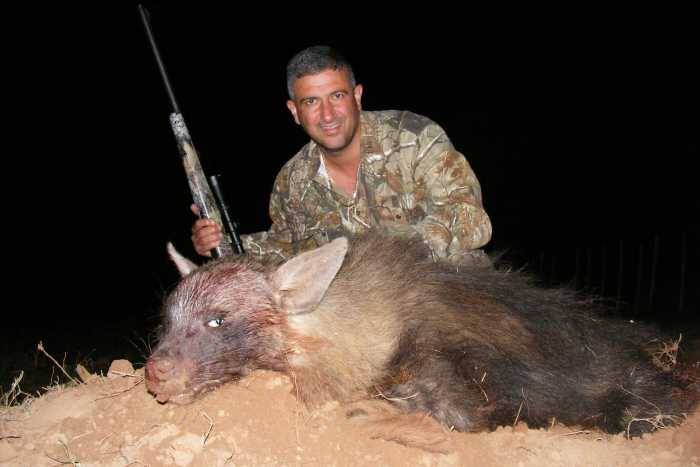
Overview
Intermediate in size between the Spotted and Striped hyena subspecies. The muzzle is comparatively short. The ears are long and extremely pointed. The coarse, very shaggy coat is dark brown in color except for a tawny-white mantle on the neck and shoulders. The head is gray. The lower legs and feet are gray with dark brown stripes. Tail is short and bushy. Genitalia are normal, unlike those of the spotted hyena.
Taxonomy
- Kingdom
- Animalia
- Phylum
- Chordata
- Class
- Mammal
- Family
- Hyaenidae
- Genus
- Parahyaena
Habitat
Dry savannas, often rocky areas with desert or thick brush, sometimes seashores. Distribution- Found only in southern Africa south of the Zambezi River, from southern Angola to mid-Mozambique. Rare within its range.
Diet
The brown hyena is mainly a scavenger, though it does take small mammals, birds, reptiles and insects, and eats fruit and crops. It is a poor hunter of larger prey, with most attempts ending in failure. In coastal regions it feeds on dead or stranded marine animals and fish. It hides surplus food for future use. Wanders great distances in the search for food.
Behavior
Very shy, cautious and nocturnal, remaining hidden by day in holes or thick cover. It forages alone, but associates loosely in clans that have fixed territories. A clan usually includes a dominant male, several subordinate males, several adult females and their young. Breeding occurs mainly May-August, with usually three cubs (range is 2-5) born August-November. The young of two or more litters may be raised together in a communal den. Its cry is a loud, melancholy wah-wah-wah. Senses of smell and hearing are very good, eyesight is good.
Hunting
The Limpopo province of South Africa is considered to be a prime region for the hunting of this hyena subspecies.
Conservation Status
Listed as Near Threatened by IUCN. This species is listed as Near Threatened as the mean global population size is estimated to be below 10,000 mature individuals, and it experiences a measure of deliberate and incidental persecution such that it may come close to meeting a continuing decline of 10% over the next three generations (24 years). It almost qualifies as threatened under criterion C1.