
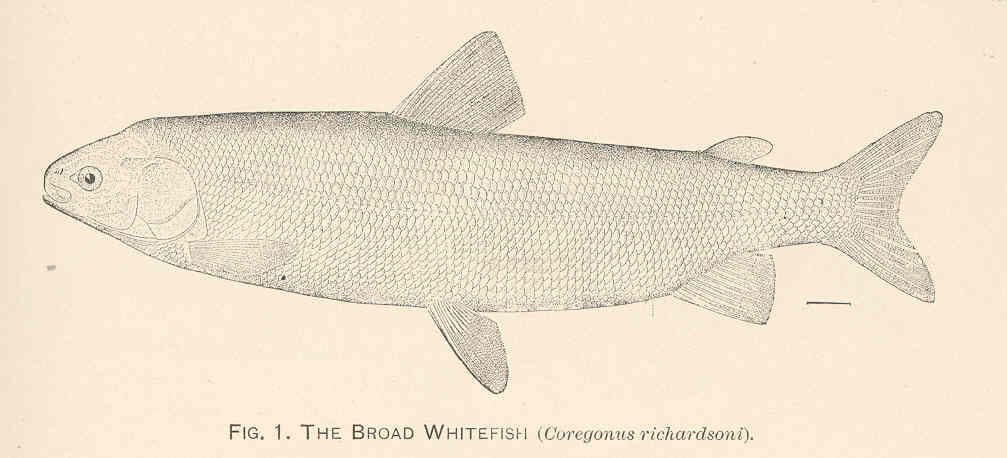
Taxonomy
- Kingdom
- Animalia
- Phylum
- Chordata
- Class
- Actinopterygii
- Order
- Perciformes
- Family
- Salmonidae
- Genus
- Coregonus
- Species
- nasus
Habitat
Broad whitefish primarily inhabit large, cold rivers, lakes, and coastal areas in the Arctic and sub-Arctic regions of North America and Eurasia. They prefer clear, oxygen-rich waters with sandy or gravelly substrates, often migrating between freshwater and brackish environments. In places like Alaska and Russia, they thrive in areas with minimal human disturbance.
Diet
Broad whitefish mainly feed on zooplankton, small insects, and aquatic invertebrates, using their specialized gill rakers to filter food from the water. They exhibit opportunistic feeding behavior, becoming more active during the summer months when food is abundant. Feeding typically occurs near the surface or mid-water in schools.
Behavior
Broad whitefish are schooling fish that form large groups for protection and feeding, often migrating seasonally to spawning grounds. They are most active during the day in cooler water temperatures and exhibit territorial behavior around nesting sites. These fish are generally adaptable but avoid heavily polluted areas.
Fishing
As a valued sport fish in Arctic and sub-Arctic regions, the Broad whitefish offers exciting angling opportunities that support conservation through license fees and habitat programs, helping maintain healthy populations in places like Alaska and Russia. Target them using trolling or casting with light tackle, such as 6-10 lb test spinning rods and reels, equipped with small lures like spoons or flies that imitate zooplankton and aquatic insects, or live bait such as worms for effective results. The best season is summer during daylight hours when they actively feed in schools near the surface or mid-water, making early morning or late afternoon ideal for higher catch rates. Focus on clear, oxygen-rich rivers, lakes, and coastal areas with sandy or gravelly substrates, where minimal disturbance allows these fish to thrive—key spots include Alaska's inland waterways and Russia's Pechora and Volonga rivers. Record sizes reach up to 9 pounds and 80 cm, underscoring their appeal as a challenging catch. Conservation efforts, including angler-funded stocking programs and regulations like catch-and-release or slot limits in certain areas, ensure sustainable populations, positioning recreational fishing as a vital tool for protecting these cold-water ecosystems.
Conservation Status
Listed as Least Concern by IUCN.