
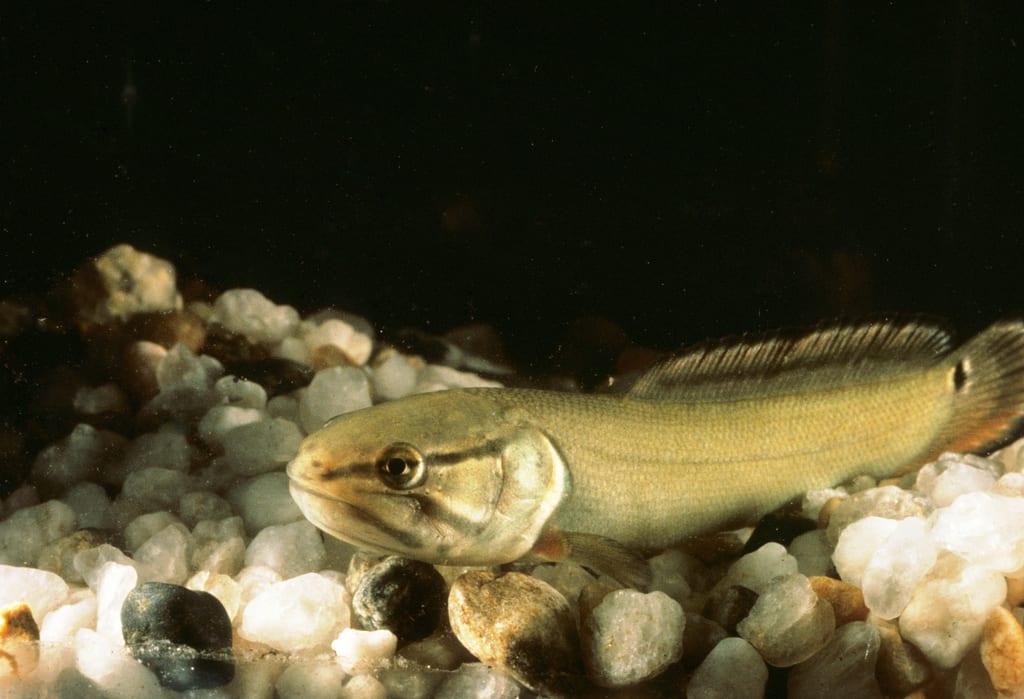
Overview
The bowfin is easily recognized by its flattened head; long, stout body; large mouth full of small, sharp teeth; long dorsal fin that extends along most of the back; and rounded tail. In the males there is a spot surrounded by an orange yellow halo on the upper area of the caudal peduncle. In the females the spot either is not ocellated or is lacking entirely. This is considered a living fossil as the sole surviving representative of the Amiiformes. It is able to gulp air from the surface directly into the air bladder, which is connected to the throat and can be used as a lung. It can also withstand high temperatures, for which reasons it survives in waters unsuited to most other fishes. Young fish have a distinctive black spot near the base of the upper portions of the tail fin. The spot is usually margined with yellow or orange. Although it persists in adult fish, it is less prominent in females.
Taxonomy
- Kingdom
- Animalia
- Phylum
- Chordata
- Class
- Actinopterygii
- Order
- Anguilliformes
- Family
- Amiidae
- Genus
- Amia
- Species
- calva
Habitat
It is able to gulp air from the surface directly into the air bladder, which is connected to the throat and can be used as a lung. It can also withstand high temperatures, for which reasons it survives in waters unsuited to most other fishes.
Diet
Initially, bowfin young feed on small invertebrates such as cladocerans (water fleas). By the time they reach about four inches in length they are primarily piscivorous, although crayfish can make up a substantial proportion of the diet, and frogs are also consumed.
Behavior
Bowfins spawn in the late spring. Nests are constructed by males in shallow, weedy areas. Vegetation and silt are removed from the nest by males and the adhesive eggs attach to any hard structure that is left, such as roots, gravel, wood, etc. Eggs hatch in 8-10 days. Males guard both incubating eggs and fry which may remain in the nest for about nine days after hatching. Young fish may grow as much as 12-14 inches during their first year. Bowfins tend to be found in deeper water during the day, and migrate into shallower areas used to feed at night. Their swim bladder is used as a lung and they may be seen surfacing to renew their air supply from time to time.
Fishing
It is considered poor as a food fish, but an excellent fighter, better than some highly rated game fish. Indeed, some anglers relish the thought of hooking a bowfin.
Conservation Status
Listed as Least Concern by IUCN.