
Overview
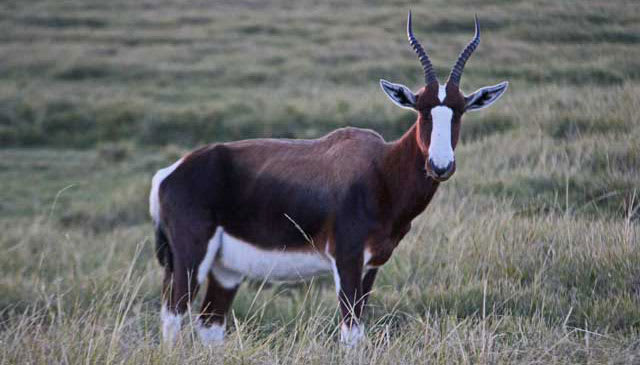
The bontebok is a medium-sized antelope, similar in shape to the tsessebe and topi, but smaller and with the back much less sloping. It is a handsome, strikingly patterned, richly colored animal. The overall color is a rich dark brown with an iridescent purplish sheen, turning silvery fawn on the shoulders and back. There is a conspicuous white facial blaze from the base of the horns to the nose-usually unbroken, but sometimes divided by a narrow brown band. The large white rump patch extends above the base of the tail. The belly, the lower legs to above the knees, and the upper part of the tail are white. The horns (both sexes) are rather small, heavily ringed and lyrate. They are black in color, with the rings rather widely spaced and completely encircling the horns. Females are similar, but smaller, and have thinner horns.
Taxonomy
- Kingdom
- Animalia
- Phylum
- Chordata
- Class
- Mammal
- Order
- Artiodactyla
- Family
- Bovidae
- Genus
- Damaliscus
- Species
- pygargus
Habitat
Open grassland. Distribution- Within recent centuries, the bontebok had a narrow range in southwestern Cape Province in South Africa, from Bot River to Mossel Bay on the coast, and inland to the Sondereind and Langeberg mountains. Today, it is found only in Bontebok National Park near Swellendam, and on a number of private ranches in South Africa where it has been introduced. Nearly all of these introductions have been outside the bontebok's natural historic range.
Diet
Exclusively a grazer. Drinks water daily.
Behavior
Gregarious, it lives in small herds. Eyesight and hearing are very good, sense of smell is good. Extraordinarily wary.
Hunting
These days, bonteboks are found only within fenced pastures, and the harvest is restricted to surplus males. Both a landowner certificate and an export permit from provincial authorities are required for export from South Africa (and for importation in the United States). Unfortunately, from the sportsman's point of view, the bontbok is collected rather than hunted, because-through some odd quirk of nature-it has never learned to be wary. But one should not abstain from taking one on this account, because if it were not for the trophy fees, few landowners would go to the expense and trouble of keeping and protecting bonteboks, and their numbers would diminish. By harvesting surplus males, sportsmen are helping to conserve and protect this rare subspecies. Some farmers have crossed bonteboks with blesboks, thereby creating hybrids that exhibit a variety of characteristics. There probably is nothing inherently wrong with this, because-if crossing and backcrossing is done conscientiously and enough times-the product should be indistinguishable from the original pure bontebok. But, unfortunately, some breeders have sold as bonteboks hybrids that are a generation or two shy of purebred development, and some professional hunters have guided clients to them. Hunters are strongly advised to learn to distinguish a purebred bontebok from a hybrid before hunting them.
Conservation Status
Listed as Least Concern by IUCN.