
Overview
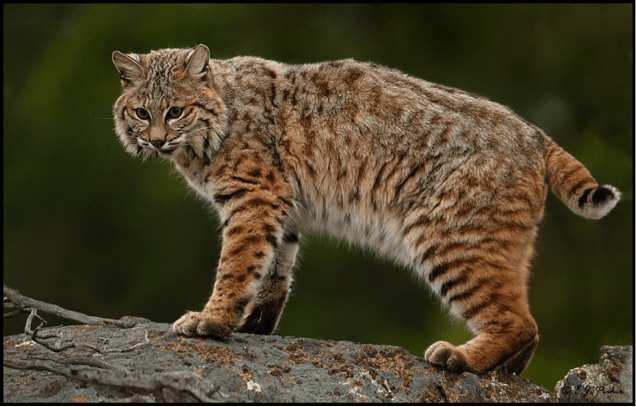
Similar to the Canadian lynx, but usually smaller, with slimmer legs, smaller feet and smaller ear tufts. The fur is shorter and occurs in various shades of brown and buff marked with dark spots and lines. The tip of the tail is black on the upper side. There is a fur ruff on the cheeks and the backs of the ears are black. Unspotted individuals sometimes occur, as well as occasional melanistic (black) or albino specimens.
Taxonomy
- Kingdom
- Animalia
- Phylum
- Chordata
- Class
- Mammal
- Order
- Carnivora
- Family
- Felidae
- Genus
- Lynx
Habitat
Will live in most types of habitat including forests, brushlands, and semideserts, but not open plains. Seldom found above 6,000 feet (1,800 m). Distribution- The southern part of every Canadian province, all 48 conterminous states of the United States, and extending southward in Mexico as far as the state of Oaxaca. Its distribution overlaps that of its close relative the Canada lynx in parts of southern Canada and northern U.S.
Diet
Carnivorous, consuming rodents, birds, and young deer. Pound for pound, the Bobcat is considered possibly the most successful mammalian predator in the world, with a very high success rate for each attempted hunt.
Behavior
The bobcat is mainly nocturnal and is a stealthy, patient hunter. Lives mostly on the ground, though it climbs trees well. Shy and secretive, but fairly tolerant of human presence. Usually silent except during courtship, when it may scream, hiss and yowl. Territorial, especially the females, and solitary except when mating. Breeding can take place at nearly any time of year, at least in some areas, but usually occurs from February to June. After 60-70 days gestation, 1-6 kittens (commonly 3) are born. Most are independent of the mother after about nine months. Females are sexually mature at one year and have been known to breed until at least 12.
Hunting
Primarily a furbearing animal that is commercially trapped, with 75,000 to 90,000 pelts taken annually and sold in an internationally regulated fur trade. By comparison, sportsmen take very few bobcats, and these are usually pursued by dogs, baited, or called by using predator calls. Only bobcats that have been hunted, not trapped, are eligible for the SCI Record Book.
Conservation Status
Listed as Least Concern by IUCN.