
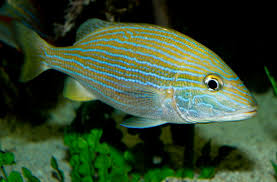
Taxonomy
- Kingdom
- Animalia
- Phylum
- Chordata
- Class
- Actinopterygii
- Order
- Perciformes
- Family
- Haemulidae
- Genus
- Haemulon
- Species
- sciurus
Habitat
Bluestriped grunts inhabit coral reefs, rocky bottoms, and seagrass beds in warm, shallow waters. They are commonly found at depths of 10 to 30 meters in the western Atlantic, from South Carolina to Brazil, including the Gulf of Mexico and Caribbean islands. These areas provide shelter and abundant food sources.
Diet
Bluestriped grunts are omnivorous, feeding on small crustaceans, worms, mollusks, and occasionally algae or detritus. They forage primarily at night over reefs and sandy bottoms, using their sensitive barbels to detect prey. Feeding activity peaks during dusk and dawn when visibility is low.
Behavior
Bluestriped grunts are schooling fish that form large groups during the day for protection, often hiding in coral crevices. They are primarily nocturnal, emerging at night to feed and making grunting sounds to communicate or ward off threats. These fish are territorial around feeding areas but generally non-aggressive toward humans.
Fishing
Target bluestriped grunts with bottom fishing techniques using light tackle for an exciting catch on coral reefs, where dropping bait to the seafloor and waiting for bites works best; use a 6- to 8-foot medium-light rod with 10- to 20-pound test line, a size 1/0 to 2/0 hook, and a sinker to reach depths of 10 to 30 meters, paired with live shrimp, small crabs, or cut bait as effective lures to mimic their natural diet of crustaceans and worms—artificial lures like jigs can also entice strikes during low-light periods. The best season is from spring through fall in warmer waters, with peak activity at dusk and dawn when these schooling fish emerge to feed nocturnally around coral reefs, rocky bottoms, and seagrass beds in the western Atlantic, from South Carolina to the Caribbean and Gulf of Mexico; focus on areas like the Florida Keys or Bahamas for consistent action. Bluestriped grunts typically reach 6 to 12 inches and up to 18 inches, with the IGFA all-tackle world record at 1 pound 12 ounces, caught in Florida, showcasing the thrill of pursuing these agile reef dwellers. Angler-funded programs, including license fees that support habitat restoration in these vital ecosystems, ensure healthy populations through effective management tools like bag limits and size regulations in places like Florida waters, promoting catch-and-release for undersized fish to maintain abundance and aid conservation efforts that protect coral reefs as critical nurseries for marine life.
Conservation Status
Listed as Least Concern by IUCN.