
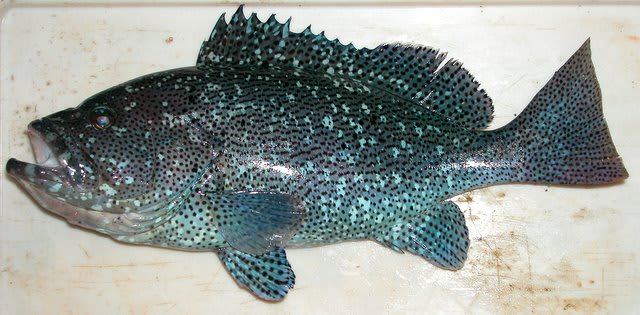
Taxonomy
- Kingdom
- Animalia
- Phylum
- Chordata
- Class
- Actinopterygii
- Order
- Scorpaeniformes
- Family
- Serranidae
- Genus
- Epinephelus
- Species
- cyanopodus
Habitat
This species primarily inhabits coral reefs, rocky bottoms, and lagoon areas in the Western Central Pacific Ocean, often at depths of 10 to 150 meters. It prefers warm tropical waters around islands and continental shelves, such as those near Japan, Australia, and Fiji.
Diet
The Blue speckled grouper feeds mainly on small fish, crustaceans like crabs and shrimp, and occasionally octopuses, using ambush predation to capture prey. It is primarily nocturnal, hunting in the dark hours over reefs and hiding during the day.
Behavior
Blue speckled groupers are solitary and territorial, defending specific reef areas from intruders. They are mostly inactive during the day, resting in crevices or under ledges, and become more active at night for feeding and movement. They exhibit cautious behavior around divers, often retreating quickly if approached.
Fishing
Anglers targeting the Blue speckled grouper, a prized sport fish in the Western Central Pacific regions like Japan, Australia, and Fiji, should focus on bottom fishing or jigging techniques around coral reefs, rocky bottoms, and lagoon areas at depths of 10 to 150 meters, where these solitary predators ambush prey. Use heavy tackle for success, including a stout rod with a high-capacity reel, 20-50 lb test monofilament or braided line, and circle hooks to minimize injury during catch-and-release; effective baits and lures include live shrimp, small fish, or crabs, as well as metal jigs and soft plastics that mimic their natural diet of crustaceans and smaller fish. The best season is during warmer months from spring to summer when spawning occurs, with peak activity at night due to their nocturnal hunting behavior—target dawn or dusk for the highest catch rates. Record sizes include the largest known specimen at 41 pounds 15 ounces, underscoring the thrill of this fishery. As a Least Concern species per IUCN, conservation is bolstered by angler-funded programs through license fees that support habitat protection and stocking initiatives, while regulations like slot limits and catch-and-release in certain areas serve as effective tools to sustain healthy populations and promote ethical fishing practices.
Conservation Status
Listed as Least Concern by IUCN.