
Overview
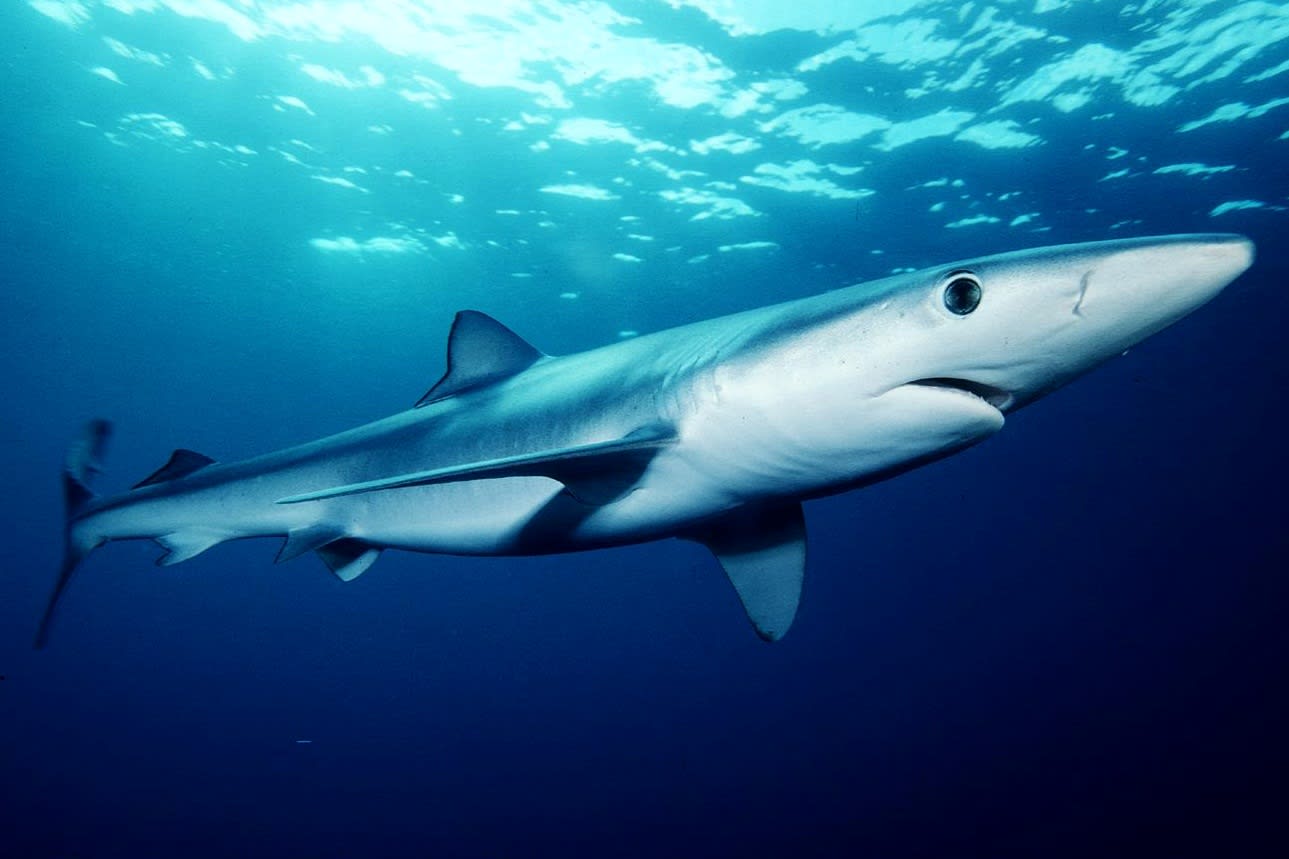
It is recognizable by its brilliant blue color. It is dark cobalt or indigo blue dorsally, lightening to bright blue on the flanks and white on the belly. It is unique among sharks in that the larger teeth of the upper jaw are “saber shaped”, with one margin broadly convex, the other concave. The teeth are serrated along the edges. Those in the lower jaw are narrower and very sharp. Caudal keels and spiracles are absent.
Taxonomy
- Kingdom
- Animalia
- Phylum
- Chordata
- Class
- Chondrichthyes
- Order
- Carcharhiniformes
- Family
- Carcharhinidae
- Genus
- Prionace
- Species
- glauca
Habitat
Inhabits cool temperate seas, often near the surface, but usually submerged to depths of 110 to 170 fathoms in the tropics or in areas with warm water currents, 50°-68°F (10°- 20°C). It is usually replaced as the common large pelagic shark by the white tip in areas of warm surface water.
Diet
Fishes, sea birds, squid and other sharks are prey to the blue shark. While not considered one of the most dangerous sharks, they have been implicated in unprovoked attacks on both humans and boats.
Behavior
They are pelagic, migratory and travel alone as well as in packs.
Fishing
Fishing methods include chumming with live or dead baits or trolling. Baits include squid, eels, mackerel, herring and other live, whole fishes or cut baits. The blue shark is viviparous, giving birth to 50 or more young at a time. It does not rate high as table fare.
Conservation Status
Listed as Near Threatened by IUCN.