
Overview
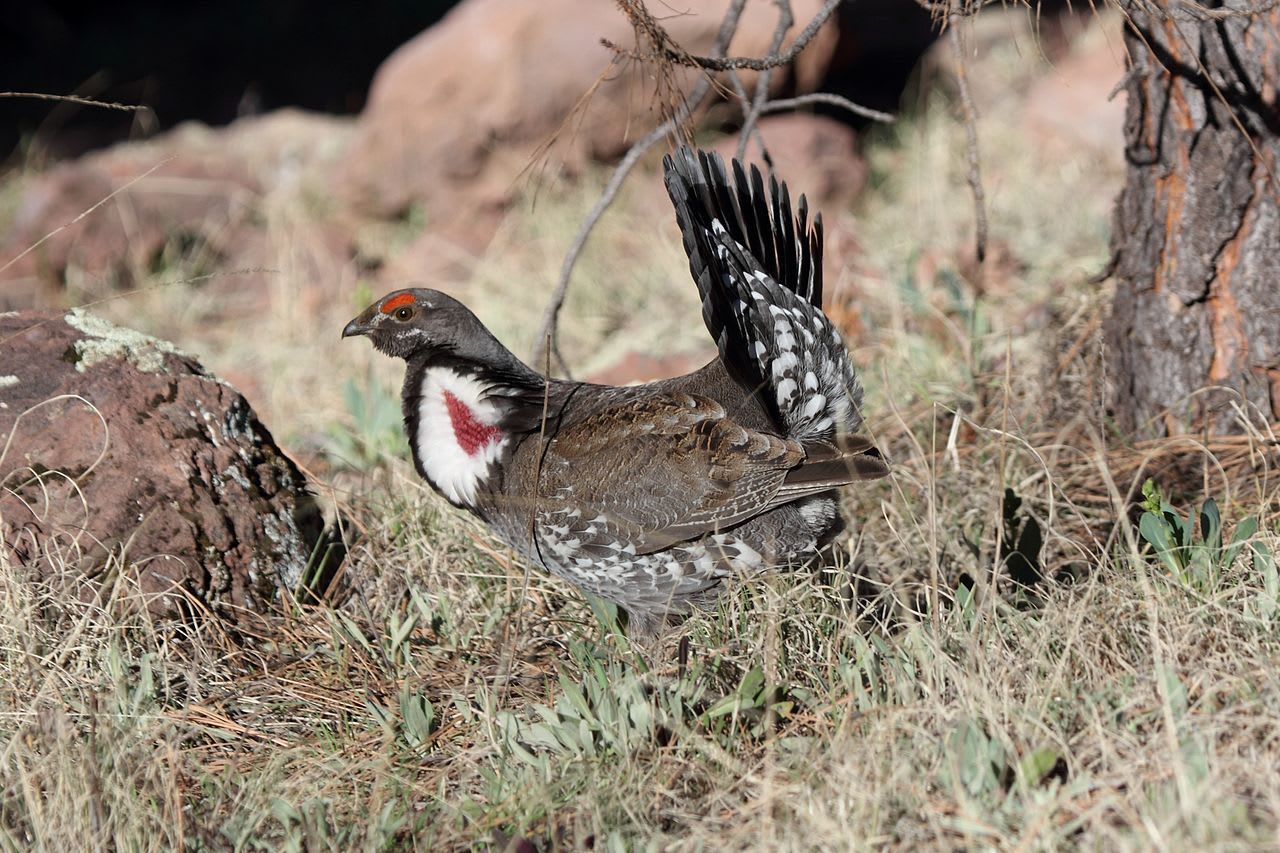
Adults have a long square tail, gray at the end. Adult males are mainly dark with a purplish throat air sac surrounded by white, and a yellow to red wattle over the eye during display. Adult females are mottled brown with dark brown and white marks on the underparts.
Taxonomy
- Kingdom
- Animalia
- Phylum
- Chordata
- Class
- Bird
- Family
- Phasianidae
- Genus
- Dendragapus
- Species
- obscurus
Habitat
They are permanent residents but move short distances by foot and short flights to denser forest areas in winter, with the odd habit of moving to higher altitudes in winter.
Diet
These birds forage on the ground, or in trees in winter. In winter, they mainly eat fir and douglas-fir needles, occasionally also hemlock and pine needles; in summer, other green plants (Pteridium, Salix), berries (Gaultheria, Mahonia, Rubus, Vaccinium), and insects (particularly ants, beetles, grasshoppers) are more important. Chicks are almost entirely dependent on insect food for their first ten days.
Behavior
They differ from other grouse species in its courtship display. Unlike other grouse species, they rely entirely on a non-vocal acoustic display, known as drumming. The drumming itself is a rapid, wing-beating display that creates a low frequency sound, starting slow and speeding up.
Hunting
Upland game bird most effectivly hunted with a bird dog. The blue grouse is one of wild game bird hunters' more challenging prey because it generally requires hiking into higher mountain areas to find and pursue.
Conservation Status
Listed as Least Concern by IUCN.