
Overview
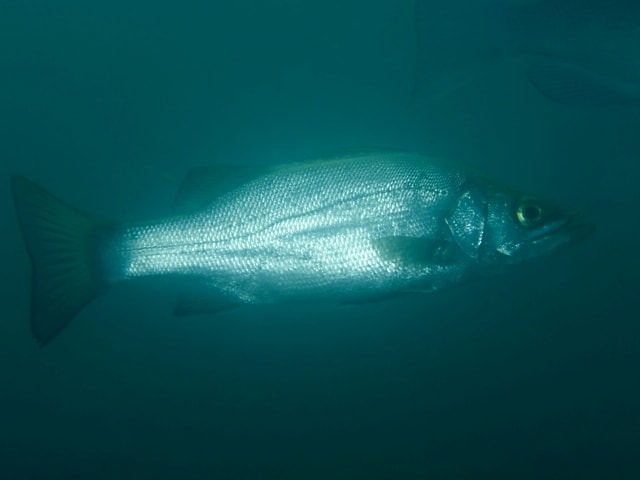
It is similar in shape to the striped bass, Morone saxatilis, of U.S. waters. It has an elongate, compressed, silvery body, a large mouth of which the lower jaw projects beyond the upper jaw, and a slightly forked tail. It lacks the stripes of Morone saxatilis. The blackfin seabass differs from the Japanese seabass in having a deeper body, a row of scales on the lower jaw, and a more silvery body color. In addition, the meristic counts of dorsal and anal fin elements differ. The blackfin seabass has 12 dorsal fin spines with 15 16 soft rays and 3 anal fin spines with 9 10 soft rays. The Japanese seabass has 12 15 dorsal fin spines with 12 14 soft rays and 3 anal fin spines with 7 9 soft rays. The lateral line pore count is 71 76 for the blackfin seabass.
Taxonomy
- Kingdom
- Animalia
- Phylum
- Chordata
- Class
- Actinopterygii
- Order
- Perciformes
- Family
- Lateolabracidae
- Genus
- Lateolabrax
- Species
- latus
Habitat
In southern waters of Japan, it is caught more often than its close relative, the Japanese seabass, Lateolabrax japonicus. Large fish are often caught in the area of shallow rocks and reefs and, in southern Japan even in the brackish waters of river mouths.
Diet
Blackfin seabass primarily feed on small fish such as anchovies and sardines, as well as crustaceans like shrimp and crabs. They are ambush predators that hunt in schools, often striking at dawn or dusk in shallow waters. Feeding behavior includes lurking near reefs and rock structures to surprise prey.
Behavior
Blackfin seabass are schooling fish that form groups in coastal areas, making them more active during twilight hours for feeding. They exhibit migratory patterns seasonally to follow prey or spawning grounds and can be territorial around reef structures. These fish are generally wary of predators, quickly dispersing when threatened.
Fishing
The Blackfin Seabass can be taken by surfcasting with flashy, minnow shaped artificial lures or metal jigs, or by fly fishing with feather streamers as well as by bait fishing with small live baits. It is highly regarded both as a food fish and as a game fish
Conservation Status
Listed as Not Evaluated by IUCN.