
Overview
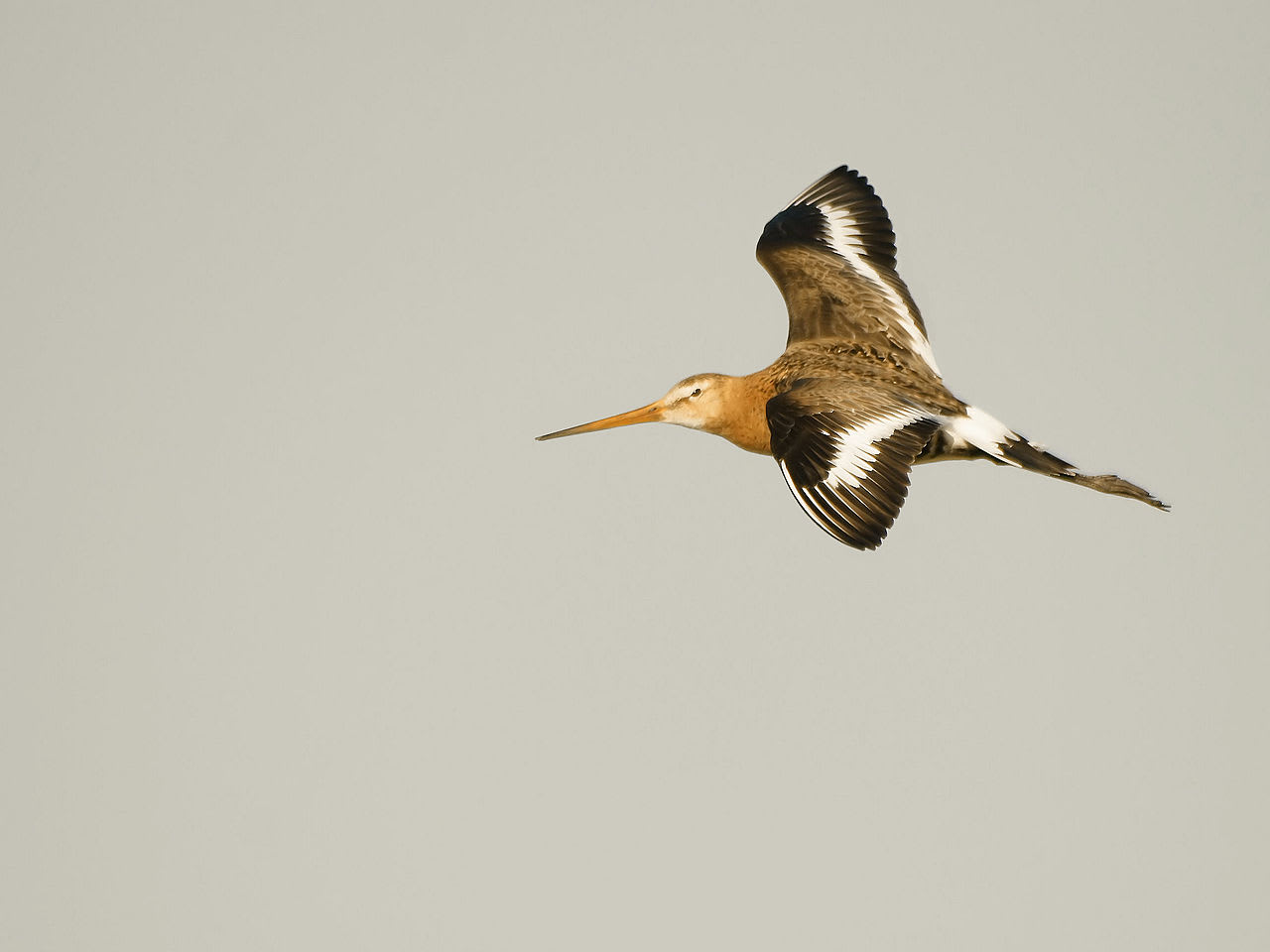
The black-tailed godwit is a large wader with long bill, neck and legs. During the breeding season, the bill has a yellowish or orange-pink base and dark tip; the base is pink in winter. The legs are dark grey, brown or black. The sexes are similar, but in breeding plumage, they can be separated by the male's brighter, more extensive orange breast, neck and head. In winter, adult black-tailed godwits have a uniform brown-grey breast and upperparts (in contrast to the bar-tailed godwit's streaked back). Juveniles have a pale orange wash to the neck and breast. In flight, its bold black and white wingbar and white rump can be seen readily. When on the ground it can be difficult to separate from the similar Bar-tailed Godwit, but the black-tailed godwit's longer, straighter bill and longer legs are diagnostic. Black-tailed godwits are similar in body size and shape to bar-taileds, but stand taller.
Taxonomy
- Kingdom
- Animalia
- Phylum
- Chordata
- Class
- Bird
- Family
- Charadriidae
- Genus
- Limosa
- Species
- limosa
Habitat
The species breeds in fens, lake edges, damp meadows, moorlands and bogs and uses estuaries, swamps and floods in (the northern hemisphere) winter; it is more likely to be found inland and on freshwater than the similar bar-tailed godwit.
Diet
They mainly eat invertebrates, but also aquatic plants in winter and on migration. In the breeding season, prey includes beetles, flies, grasshoppers, dragonflies, mayflies, caterpillars, annelid worms and molluscs. Occasionally, fish eggs, frogspawn and tadpoles are eaten.
Behavior
Black-tailed godwits are mostly monogamous; although it was not recorded in a four-year study of 50–60 pairs, bigamy was considered probably frequent. A study of the Icelandic population showed that despite spending winter apart, pairs are reunited on their breeding grounds within an average of three days of each other. If one partner does not arrive on time, 'divorce' occurs. They nest in loose colonies. Unpaired males defend a temporary territory and perform display flights to attract a mate. Several nest scrapes are made away from the courtship territory, and are defended from other godwits. Once eggs are laid, an area of 30–50 m (98–164 ft) around the nest is defended. The nest is a shallow scrape on the ground, usually in short vegetation. The eggs may be hidden with vegetation by the incubating parent. The single brood of three to six eggs, coloured olive-green to dark brown, measure 55 mm × 37 mm (2.2 in × 1.5 in) and weigh 39 g (1.4 oz) each (of which 6% is shell). Incubation lasts 22–24 days and is performed by both parents. The young are downy and precocial and are brooded while they are small and at night during colder weather. After hatching, they are led away from the nest and may move to habitats such as sewage farms, lake edges, marshes and mudflats. The chicks fledge after 25–30 days. Black-tailed godwit productivity varies, positively, with spring temperatures. However, during extreme events, such as a volcanic eruption, complete breeding failures can occur
Hunting
More information is needed.
Conservation Status
Listed as Near Threatened by IUCN.