
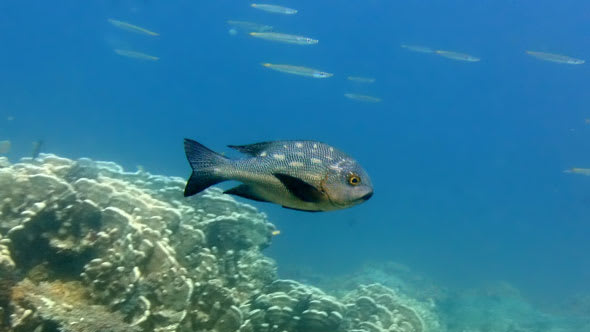
Taxonomy
- Kingdom
- Animalia
- Phylum
- Chordata
- Class
- Actinopterygii
- Order
- Perciformes
- Family
- Lutjanidae
- Genus
- Apsilus
- Species
- dentatus
Habitat
Black snappers primarily inhabit deep waters of the Western Central Atlantic, including coral reefs, rocky ledges, and submarine slopes at depths of 100 to 400 meters. They prefer areas with strong currents and abundant cover for protection. These fish are commonly found around the Bahamas, Caribbean islands, and other tropical regions.
Diet
Black snappers feed mainly on smaller fishes, squid, and crustaceans, using their sharp teeth to capture prey. They are primarily nocturnal hunters, ambushing food from hiding spots in reefs. Feeding occurs in deeper waters where visibility is low.
Behavior
Black snappers are typically solitary or form small groups, exhibiting nocturnal activity to hunt and avoid predators. They are territorial around reef structures and use camouflage for protection. These fish are known for their cautious nature, often darting into crevices when threatened.
Fishing
Target black snapper, a prized deep-water species in the Western Central Atlantic and Caribbean regions like the Bahamas and Puerto Rico, using proven bottom fishing or deep-dropping techniques with heavy tackle to reach depths of 100 to 400 meters around coral reefs, rocky ledges, and submarine slopes; deploy strong 50-80 lb test monofilament or braided lines on robust conventional reels paired with stout rods, circle hooks, and weights to handle the strong currents and the fish's powerful runs, while using live bait such as squid, small fish, or crustaceans, or effective lures like jigs and diamond rigs that mimic their natural prey for the best strikes. The prime season runs from spring through fall during warmer months when they're more active, with nighttime being optimal due to their nocturnal hunting behavior, increasing your chances of a solid catch in low-light conditions. Focus on areas with abundant cover and strong currents for protection, as these spots not only hold black snappers but also support healthy reef ecosystems; the IGFA all-tackle world record stands at 18 pounds 8 ounces, caught in the Bahamas in 2007, showcasing the potential for thrilling angling achievements. Conservation-wise, black snappers are listed as Least Concern by the IUCN with stable populations, and angler-funded programs through license fees help protect these deep-water habitats—practice catch-and-release for larger fish to maintain breeding stocks and adhere to local slot limits or seasonal closures as effective tools that ensure sustainable fisheries and vibrant marine environments for future generations.
Conservation Status
Listed as Least Concern by IUCN.