
Overview
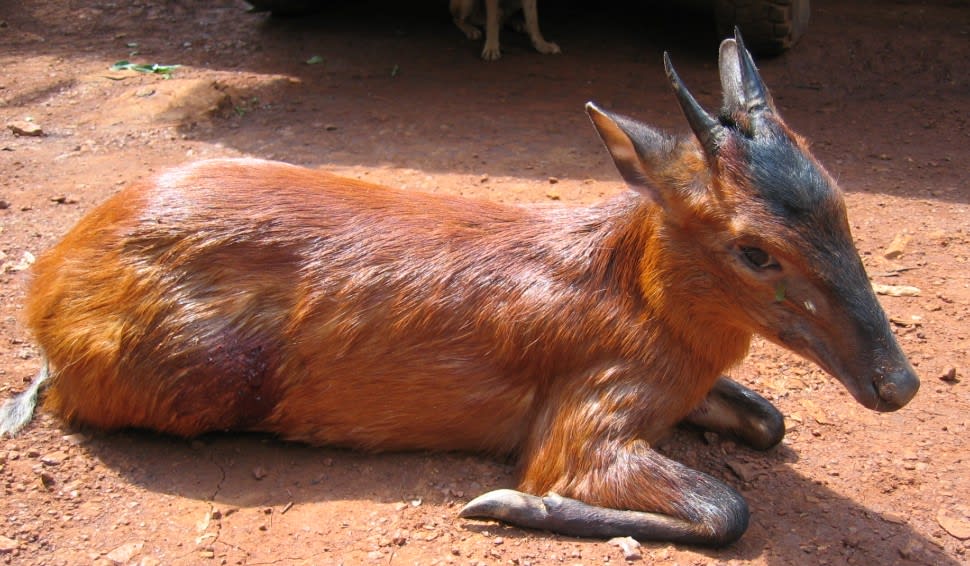
A medium-sized duiker with relatively long legs and a coarse coat. The general color is rich chestnut, with underparts the same or very slightly lighter. It is distinguished from other duikers by the wide black nose stripe connecting to the black forehead, and by the blackish lower legs and feet. The black facial blaze contrasts strongly with the lighter eyebrow streak and the reddish sides of the face. The well-developed head tuft is mostly black, with a few reddish hairs mixed in. The tail has a blackish tuft with a white tip. There is no dorsal stripe. The hoofs are elongated and the false hoofs are large, which are adaptations for walking on soft marshy ground. Inguinal (groin) glands are said to be present in some populations, absent in others. The horns (both sexes) are thick at the base, strongly ridged, oval in section, with very thin straight tips, and grow backward in the plane of the face. Females are similar to males, but have smaller horns.
Taxonomy
- Kingdom
- Animalia
- Phylum
- Chordata
- Class
- Mammal
- Order
- Artiodactyla
- Family
- Bovidae
- Genus
- Cephalophus
Habitat
Rain forest, including mountain rain forest, especially in marshy areas. Distribution- Southern Cameroon; the extreme southwestern tip of the Central African Republic; possibly in Rio Muni; parts of Gabon; northern Congo (B); northern and central Congo (K) eastward to the Virunga volcanoes, where found as high as 11,500 feet (3,500 m); and the lower slopes of the Ruwenzori Mountains of northeastern Congo (K) and southwestern Uganda. Also an isolated population from 8,000-11,500 feet (2,400-3,500 m) on Mt. Elgon on the Uganda-Kenya border, and another above about 8,500 feet (2,600 m) on Mt. Kenya; on both mountains it is most common in the bamboo zone. Formerly found in the Aberdare mountains in Kenya. Also occurs in western Rwanda and northwestern Burundi.
Diet
These animals browse on plants and fallen fruit.
Behavior
Territorial and at least partly diurnal.
Hunting
Many hunts take place in Cameroon and it is best taken by shot-gun or a large caliber solid bullet. They can be found by spot and stalk methods or can be called in by using distress calls.
Conservation Status
Listed as Least Concern by IUCN.