
Overview
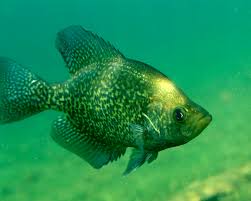
Crappies are members of the sunfish and black bass family, and though they show a definite family resemblance, they are distinctive enouth that they shouldn’t be confused with any other species. The black crappie and the white crappie (Pomoxis annularis) are most often confused with each other. Despite their common names, both species are the same color (dark olive or black dorsally with silvery sides) and both have spots on the sides. However, the pattern of the spotting is distinctly different. In the black crappie the spots are more or less irregular and scattered while in the white crappie the spots may be more vague and are clearly arranged into 7 9 vertical bars on the sides. Another distinction; the black crappie has 7 8 dorsal spines while the white crappie has only 6, the same number as in its anal fin. In body shape the black crappie is somewhat deeper than the white crappie.
Taxonomy
- Kingdom
- Animalia
- Phylum
- Chordata
- Class
- Actinopterygii
- Order
- Cypriniformes
- Family
- Centrarchidae
- Genus
- Pomoxis
- Species
- nigromaculatus
Habitat
Native to most of the eastern half of the U.S.A., the black crappie has stocked throughout been so extensively transplanted that today it almost entirely blankets the U.S. and reaches up into southern Manitoba, Ontario and Quebec in Canada. It is only noticeably scarce in a swathe of the midwest stretching from western Texas up through Nevada, Colorado, Utah, Wyoming, Idaho and western Montana, and even these states have black crappies either along their borders or in limited internal areas. The black crappie inhabits large ponds and shallow areas of lakes, with sandy or muddy bottoms and usually in areas of abundant vegetation. It requires a deeper, clearer, somewhat cooler habitat than does the white crappie.
Diet
Black crappie adults feed on fewer fish, than do white crappie. They prefer: shad, crustaceans, plankton, minnows, small fish, insects.
Behavior
Like other members of the sunfish family, black crappie are nest builders. They nest in the spring, generally when water temperatures reach 60°F. Males do not develop specialized breeding coloration during spawning season.
Fishing
It is an abundant species and is important both commercially and as a sport fish. Black crappies are easily caught, often as fast as the hook can be rebaited.
Conservation Status
Listed as Least Concern by IUCN.