
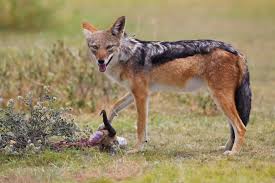
Overview
The jackal is a medium sized member of the dogfamily, originally found in Africa, Asia and southeast Europe. There are four main species of jackal being the Golden jackal, the Side-striped jackal, the Black-backed jackal and the Ethiopian wolf jackal. The Golden jackal is the most northernly species of jackal and can be found as far east as Burma in Southeast Asia.
Taxonomy
- Kingdom
- Animalia
- Phylum
- Chordata
- Class
- Mammal
- Order
- Carnivora
- Family
- Canidae
- Genus
- Canis
Habitat
Moutains, savannahas, and wooded areas.
Diet
Antelope, Reptiles, Insects
Behavior
Jackals inhabit crevices in rocks and dens made by other animals in order to keep the jackals cool while they sleep. Although many jackal individuals live a nocturnal existence, particularly those jackals that inhabit areas close to humans, some jackals in more remote areas are slightly more diurnal and will be out hunting during the cooler times of the day.
Hunting
The Black-backed Jackal is a challenging varmint species hunted primarily for population control and as a secondary trophy in sub-Saharan Africa, where regulated hunting supports wildlife management and reduces conflicts with livestock. Effective methods include spot-and-stalk approaches in open savannahs, using predator calls to lure them out, or night hunting with spotlights for better visibility; always prioritize accurate shot placement to the chest or head for a quick, ethical harvest. Use calibers like .22-250 or .223 Remington for their precision at medium ranges, paired with a good scope for low-light conditions. The best timing is during the dry winter months, such as June to September in southern Africa, when jackals are more active and visibility is high, but confirm local regulations for season specifics. Trophy criteria focus on pelt quality and size, with records tracked by Safari Club International (SCI), where larger specimens with intact fur command higher scores. Legal hunting occurs in countries like South Africa, Namibia, and Botswana, often on private game ranches or conservancies, where hunting fees contribute to anti-poaching efforts and habitat protection, demonstrating how regulated harvest programs maintain stable populations and fund conservation initiatives under models similar to Southern African conservancy systems.
Conservation Status
The Black-backed Jackal is classified as Least Concern by the IUCN, with a stable population trend across its range in sub-Saharan Africa. Major threats include persecution by farmers due to livestock predation and habitat loss from human expansion.