
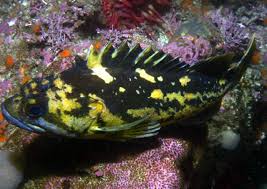
Taxonomy
- Kingdom
- Animalia
- Phylum
- Chordata
- Class
- Actinopterygii
- Order
- Salmoniformes
- Family
- Sebastidae
- Genus
- Sebastes
- Species
- chrysomelas
Habitat
This species primarily inhabits rocky reefs, kelp forests, and areas with abundant crevices in the eastern Pacific Ocean. It prefers depths from 0 to 46 meters, commonly found along the coast from central California to Baja California, Mexico. These environments offer shelter and abundant prey.
Diet
Black-and-yellow rockfish mainly consume small fishes, crustaceans like shrimp and crabs, and mollusks. They are ambush predators that hunt during the day, hiding in rocky structures to surprise their prey. Feeding activity peaks in the morning and late afternoon.
Behavior
These rockfish are typically solitary or form small loose groups, often defending territories around rocky reefs. They are diurnal, active during the day for feeding and resting at night in crevices. They exhibit cautious behavior, quickly retreating into hiding when threatened.
Fishing
Anglers targeting Black-and-yellow rockfish, a popular sport fish in California's coastal waters, should focus on bottom fishing techniques using bait or light jigging to probe rocky structures and kelp forests. Use medium-light tackle, such as a 7-9 foot rod with 10-20 lb test line, paired with size 1-2 hooks and 1-2 oz sinkers to effectively reach depths of 0-46 meters; opt for baits like shrimp, crabs, or small fish imitations, as these mimic the rockfish's diet of crustaceans and small fishes for better strikes. The best seasons are spring through fall, with prime fishing times in the morning and late afternoon when these diurnal predators are most active; target habitats along the eastern Pacific coast from central California to Baja California, focusing on reefs and crevices for higher success rates. Record sizes include weights up to 1 lb 4 oz and lengths of 15-25 cm, though IGFA records for this species are not prominent. Conservation-wise, angler-funded programs through license fees support habitat protection and stock assessments, with regulations like bag limits and seasonal closures in California serving as effective tools to maintain stable populations and promote catch-and-release for smaller fish, ensuring the long-term health of rockfish stocks.
Conservation Status
Listed as Not Evaluated by IUCN.