
Overview
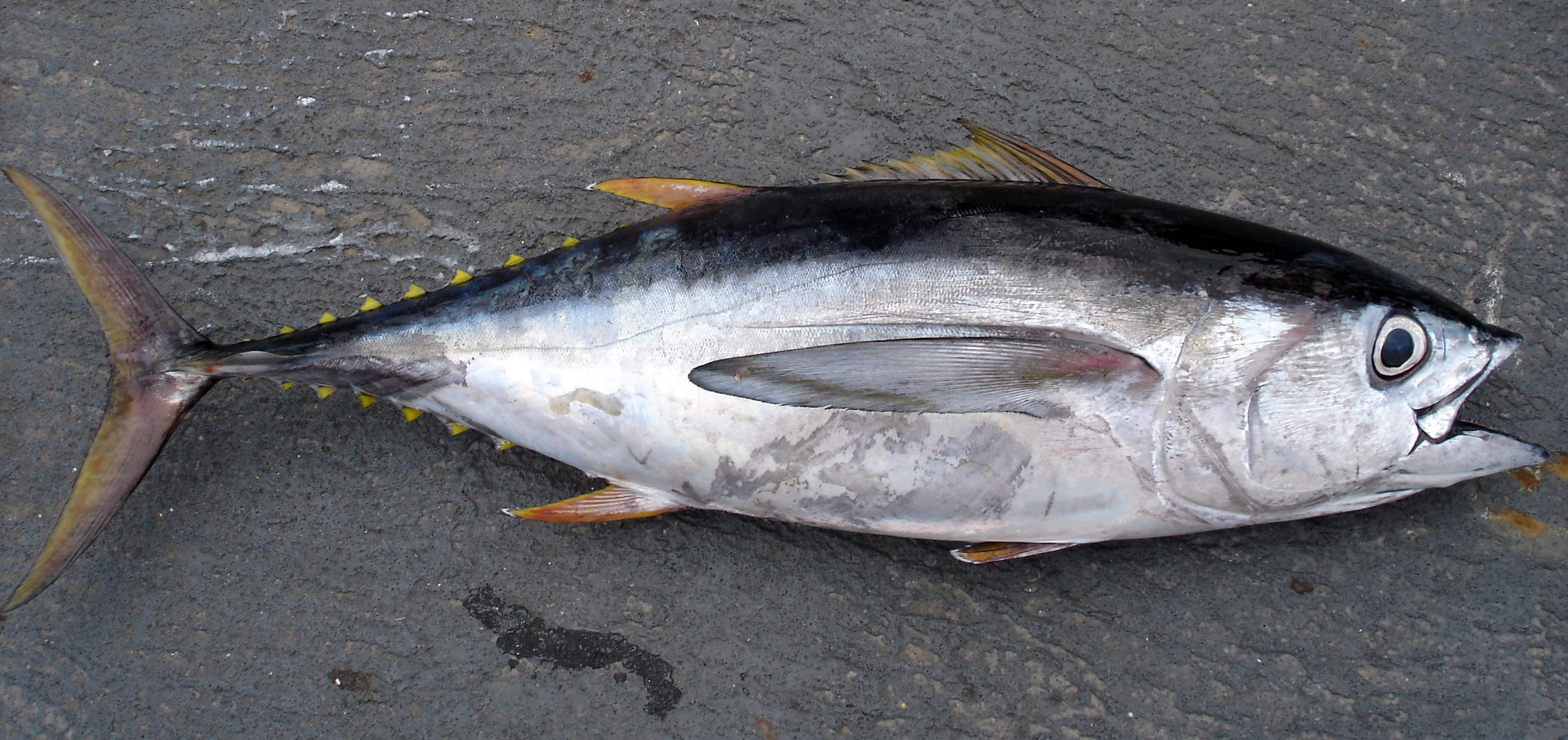
The pectoral fins may reach to the second dorsal fin. The second dorsal and anal fins never reach back as far as those of large Yellowfin tuna (Thunnus albacares). It has a total of 23 31 gill rakers on the first arch. The margin of the liver is striated. The two dorsal fins are close set, the first having 13 14 spines and the second, 14 16 rays. The anal fin has 11 15 rays. On either side of the caudal peduncle there is a strong lateral keel between two small keels that are located slightly farther back on the tail. The scales are small except on the anterior corselet. The vent is oval or teardrop shaped, not round as in the albacore. The first dorsal fin is deep yellow. The second dorsal fin and the anal fin are blackish brown or yellow and may be edged with black. The finlets are bright yellow with narrow black edges. The tail does not have a white trailing edge like that of the albacore. Generally, there are no special markings on the body, but some specimens may have vertical rows of whitish spots on the venter.
Taxonomy
- Kingdom
- Animalia
- Phylum
- Chordata
- Class
- Actinopterygii
- Order
- Pleuronectiformes
- Family
- Scombridae
- Genus
- Thunnus
- Species
- obesus
Habitat
Found in warm temperate waters, this schooling, pelagic, seasonally migratory species is suspected of making rather extensive migrations. Schools bigeye tuna generally run deep during the day. Schools of bluefin, yellowfin and some others are known to occasionally swim at the surface, especially in warm water.
Diet
Its diet includes squid, crustaceans, mullet, sardines, small mackerels and some deep water species.
Behavior
Bigeye tuna are highly migratory and form large schools, particularly juveniles, which helps them in foraging and predator avoidance across vast oceanic ranges. They exhibit diurnal vertical migrations, descending to depths of up to 600 meters during the day and ascending to shallower waters at night to feed. This behavior allows them to exploit different prey layers and maintain their energy demands in the open ocean. They are also known for their ability to regulate body temperature, enabling sustained high-speed swimming.
Fishing
Fishing methods are trolling deep with squid, mullet or other small baits, or artificial lures and live bait fishing in deep.
Conservation Status
Listed as Vulnerable by IUCN.