
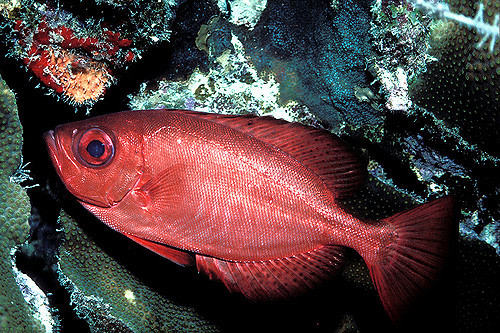
Taxonomy
- Kingdom
- Animalia
- Phylum
- Chordata
- Class
- Actinopterygii
- Order
- Perciformes
- Family
- Priacanthidae
- Genus
- Priacanthus
- Species
- arenatus
Habitat
Bigeye fish primarily inhabit coral reefs, rocky substrates, and sandy bottoms in tropical and subtropical marine waters. They prefer depths ranging from 10 to 400 meters, often seeking shelter in crevices or under ledges during the day. Geographically, they are common in the Western Central Atlantic, including areas around the Caribbean and Brazil.
Diet
Bigeye fish are carnivorous, feeding mainly on small fish, shrimps, crabs, and other crustaceans. They hunt nocturnally, using their large eyes to spot prey in dim light, and often ambush from hiding spots. Feeding activity peaks at night when they are most active.
Behavior
Bigeye fish are primarily nocturnal, resting in reef crevices during the day and becoming active hunters at night. They often form loose schools but can also be solitary, and exhibit territorial behavior around their hiding areas. They are agile swimmers, using quick bursts of speed to catch prey or evade threats.
Fishing
Target Bigeye (Priacanthus arenatus) with effective bottom fishing or vertical jigging techniques, especially at night when they are most active as nocturnal hunters; use medium-heavy spinning or conventional rods with 20-50 lb test line, strong reels, and circle hooks to ensure secure hooksets and promote ethical release. Opt for fresh bait like shrimp, small fish, or crabs, or artificial lures such as jigs and soft plastics that mimic their crustacean and fish prey for better strikes in low-light conditions. The best seasons are year-round in tropical waters, with peak activity during warmer months and nighttime hours for optimal success; focus on coral reefs, rocky substrates, and sandy bottoms in the Western Central Atlantic, including the Caribbean and areas off Brazil, at depths of 10-400 meters where they shelter during the day. Record sizes include fish up to 6 pounds 4 ounces and 45 cm, supporting their status as a rewarding sport fish, though specific IGFA records for this species are less common compared to related game fish. As a Least Concern species per IUCN, conservation is bolstered by angler-funded programs through license fees that support habitat restoration and stocking efforts, with practices like slot limits and catch-and-release helping maintain stable populations and ensuring sustainable fishing as a key tool for marine conservation.
Conservation Status
Listed as Least Concern by IUCN.