
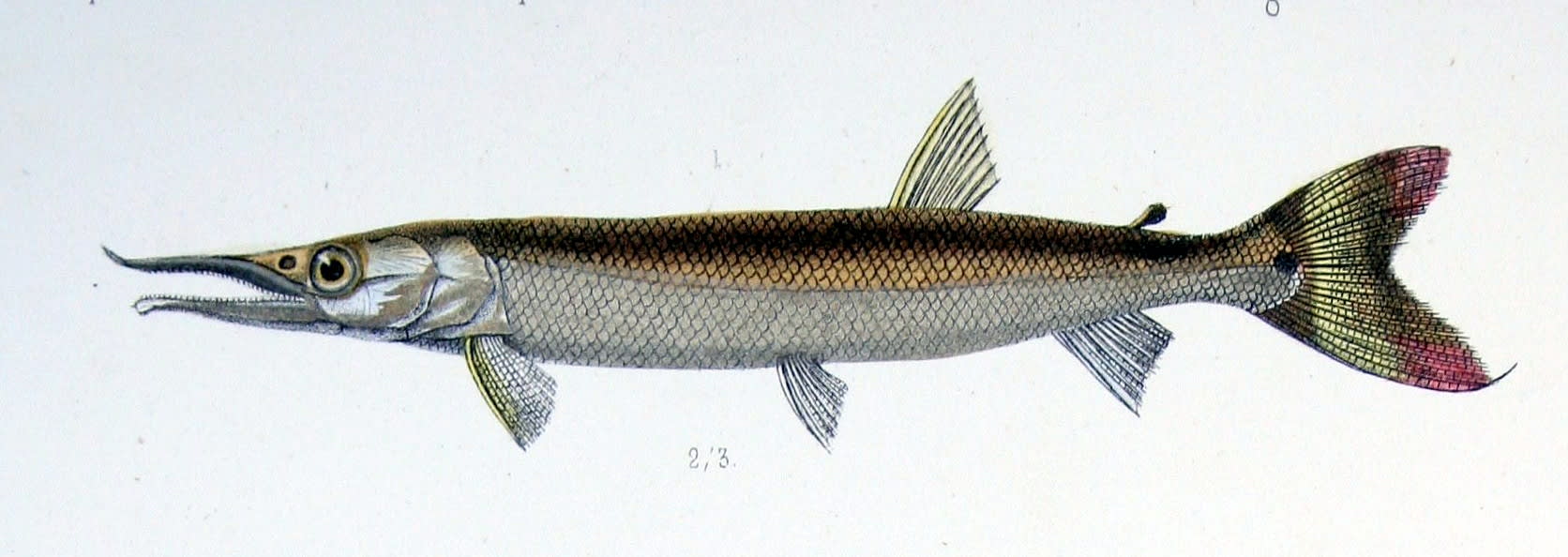
Taxonomy
- Kingdom
- Animalia
- Phylum
- Chordata
- Class
- Actinopterygii
- Order
- Istiophoriformes
- Family
- Ctenoluciidae
- Genus
- Boulengerella
- Species
- cuvieri
Habitat
Bicuda primarily inhabits large rivers and their tributaries in the Amazon and Orinoco basins, preferring clear to slightly turbid waters with submerged vegetation or woody debris for cover. They are found in both slow-moving and fast-flowing sections, often in warmer tropical regions of South America.
Diet
Bicuda feeds mainly on smaller fish such as characins and tetras, as well as insects, crustaceans, and occasionally frogs. They are ambush predators that hunt by sight, typically active during the day in open water or near structures.
Behavior
Bicuda are solitary and territorial fish that aggressively defend their hunting areas. They are diurnal, spending much of their time lurking in cover to ambush prey, and they exhibit rapid, explosive strikes when feeding. During the breeding season, they may become more active and competitive for spawning sites.
Fishing
Target Bicuda, a thrilling sport fish in South America's Amazon and Orinoco basins, using aggressive casting or trolling techniques with artificial lures that imitate small fish, such as spoons, spinners, or soft plastics, to trigger their explosive strikes as ambush predators. For tackle, use a medium-action spinning rod with a reel spooled in 10-20 pound monofilament or braided line, paired with lures in the 1-4 inch range for optimal presentation; live bait like small characins can also work but requires careful handling to promote catch-and-release. The best season is during the rainy months from November to March when they are more active and spawning, with prime fishing times in the early morning or late afternoon in daylight hours; year-round opportunities exist in tropical regions. Focus on habitats with submerged vegetation, woody debris, or structures in large rivers like the Rio Amazonas or Río Orinoco, where clear to slightly turbid waters provide ideal cover—cast near these areas for the best results. Bicuda can reach up to 16 pounds and lengths of 50-100 cm, though specific IGFA records are not widely documented. Regulated fishing for Bicuda, supported by angler license fees, plays a key role in conservation by funding habitat protection and population monitoring in these biodiverse waterways, ensuring sustainable practices like slot limits in some areas help maintain healthy stocks.
Conservation Status
Listed as Not Evaluated by IUCN.