
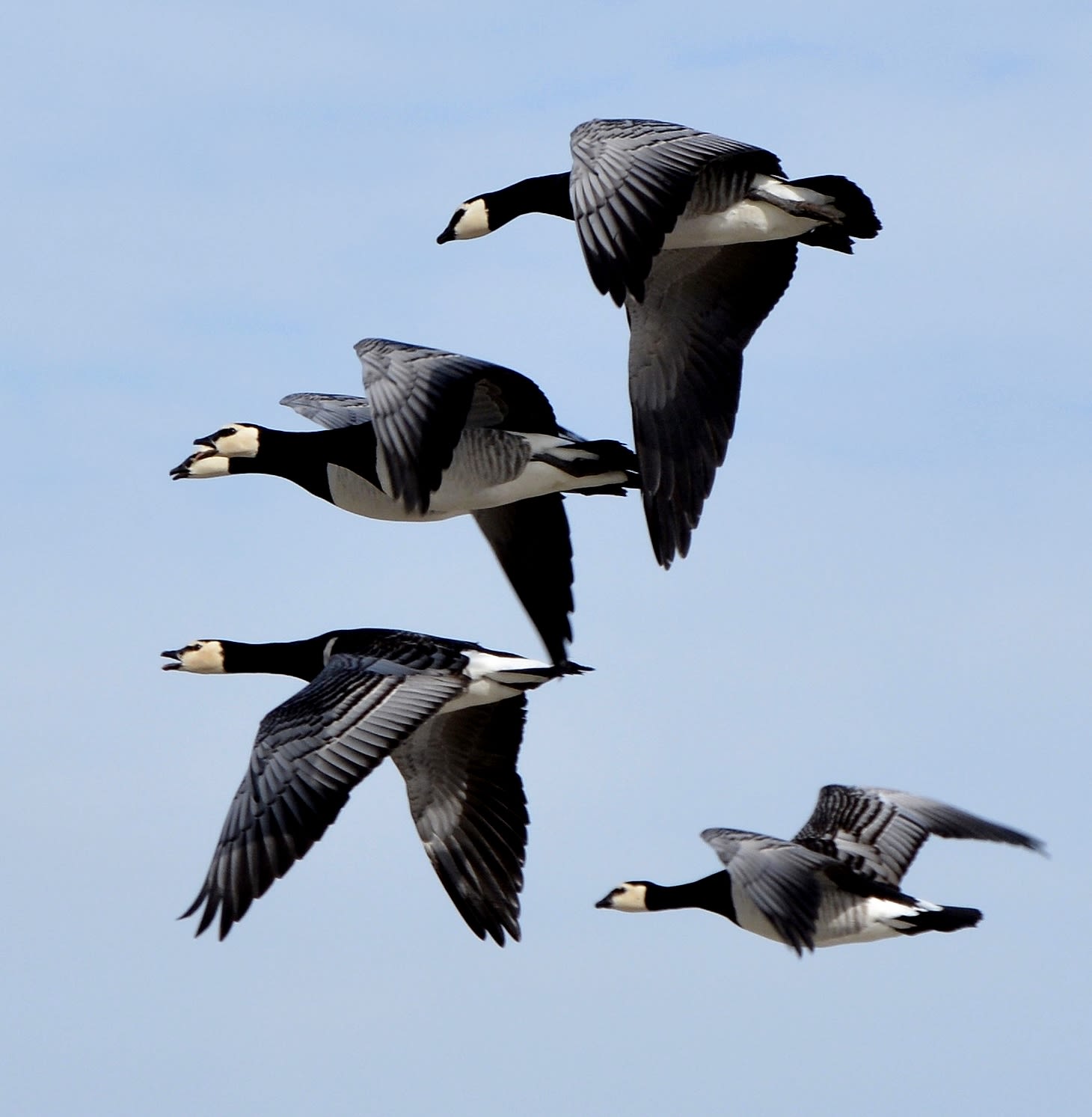
Taxonomy
- Kingdom
- Animalia
- Phylum
- Chordata
- Class
- Bird
- Family
- Anatidae
- Genus
- Branta
- Species
- leucopsis
Habitat
Barnacle geese breed in Arctic and sub-Arctic regions on coastal cliffs and islands, such as in Greenland and Svalbard. In winter, they migrate to temperate areas like the Netherlands and United Kingdom, preferring grasslands, wetlands, and agricultural fields for feeding.
Diet
Barnacle geese primarily eat grasses, sedges, and grains, with a preference for fresh vegetation in pastures and fields. They feed mainly during the day in flocks, grazing intensively, and may also consume aquatic plants near water bodies.
Behavior
Barnacle geese are highly social birds that form large flocks during migration and wintering, but become territorial during the breeding season. They are diurnal and exhibit strong pair bonds, with pairs often mating for life. These geese are accomplished migrators, traveling long distances between Arctic breeding grounds and temperate winter habitats.
Hunting
The Barnacle goose is a regulated game bird primarily hunted in Europe, including countries like the United Kingdom, Netherlands, Germany, Sweden, Norway, Finland, Belgium, and Russia, with some opportunities in Greenland under specific Danish oversight; it's not hunted in North America. Effective methods involve shotgun hunting from concealed blinds or open fields, using decoys, calls, and careful timing to intercept migratory flocks, with shots taken at distances up to 40 yards for clean harvests. Recommended equipment includes a 12-gauge or 20-gauge shotgun loaded with non-toxic steel shot in sizes BB to 4 for ethical and effective patterning, paired with moisture-resistant camouflage gear to blend into wetland or agricultural environments. The best seasons align with migration and winter periods, typically from September to February, varying by country to coincide with population peaks and ensure sustainable harvests; always check local regulations for bag limits and licensing. While Barnacle geese aren't typically pursued for formal trophies, larger birds may be noted in European hunting records for wingspan or weight, supporting conservation through hunter-funded programs that contribute to habitat preservation and anti-poaching efforts, as regulated hunting helps maintain stable populations under the IUCN Least Concern status by funding monitoring and management initiatives.
Conservation Status
The IUCN status of the Barnacle goose is Least Concern, with a stable or increasing population trend due to conservation efforts. Major threats include habitat loss from agricultural expansion and hunting in some regions.