
Overview
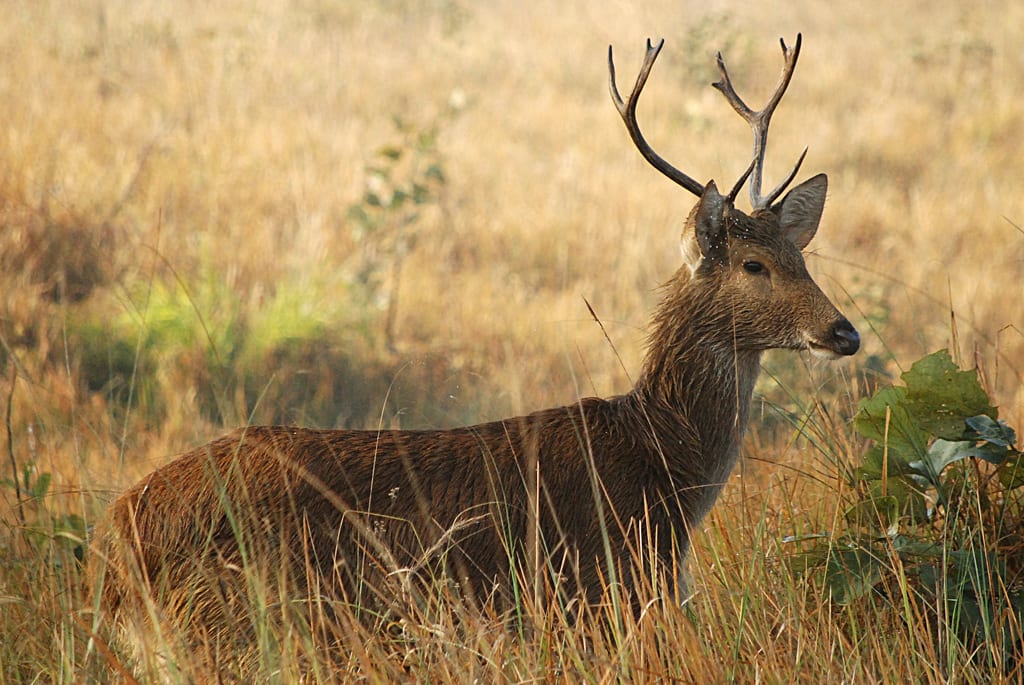
A large, graceful deer, though somewhat stoutly built. The summer coat is a rich golden-brown with a darker dorsal line, but without the spots that develop in its native India. The long, coarse winter coat is a dull grayish-brown with lighter underparts, and males grow a prominent neck ruff. The main antler beams are smooth and flattened, with a long brow tine that sprouts close to the burr, but without bez or trez tines. A set of antlers may have 10-15 or more total points in a variety of configurations. Typically, the brow tine grows from the main beam at almost a right angle, after which the beam is free of tines for half its remaining length, whereupon it divides evenly and each branch divides again. In another form, the antlers somewhat resemble those of the brow-antlered or Eld deer, with a long, curved brow tine growing at more than a right angle from the main beam so that it appears to be almost a continuation of it. A variety of intermediate antler forms can also occur. Extra tines are often found in the tops, and small snags sometimes grow from the upper surface of the brow tine.
Taxonomy
- Kingdom
- Animalia
- Phylum
- Chordata
- Class
- Mammal
- Order
- Artiodactyla
- Family
- Cervidae
- Genus
- Rucervus
Habitat
Grasslands and lightly wooded areas. Distribution- Isolated pockets in southwestern Nepal and Uttar Pradesh, India. Has been introduced to private ranches in the Texas hill country.
Diet
Mainly grasses and aquatic plants.
Behavior
In Nepal and Uttar Pradesh it lives in swampy land and is seldom out of water. The rut in northern India and Nepal peaks about November, although mating can occur from September to April. In eastern India it begins in late April and continues until about December, with the peak probably in August. The single fawn is born 8 to 8-1/2 months later. Females first give birth when about three years of age, and once a year thereafter.
Hunting
A copy of the US Fish & Wildlife harvest permit must accompany the score sheet in order for the record book to consider the entry.
Conservation Status
Listed as Vulnerable by IUCN.