
Overview
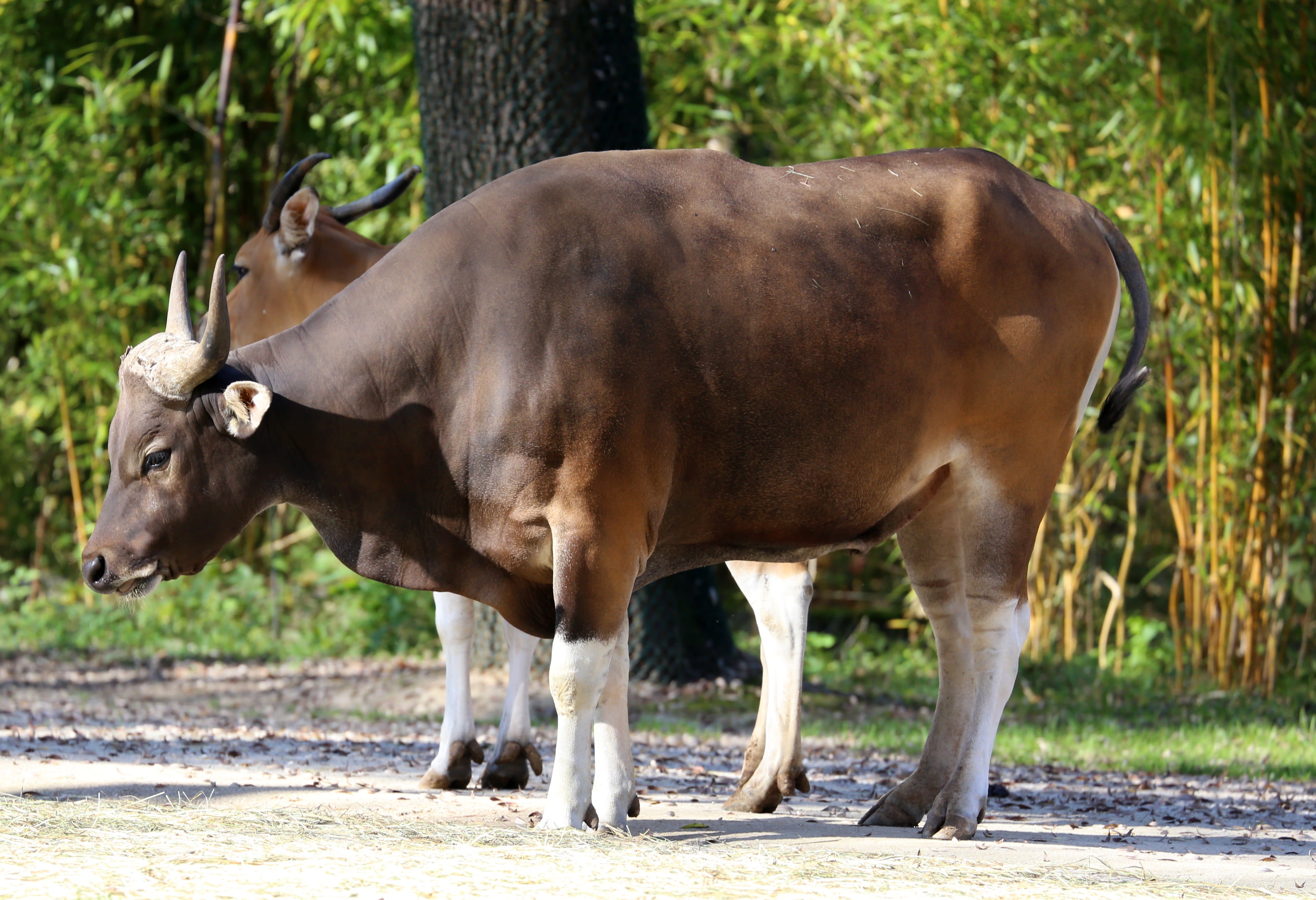
The banteng is a good-sized ox, closely related to the gaur, but smaller and lighter, with a less developed dorsal ridge, relatively longer legs, a more elongated head and smaller ears. The tail is tufted and reaches below the hocks, and there is an imperfectly developed dewlap. Banteng found in Australia are handsome animals of the Javan type. Young bulls are reddish-brown until about age three, becoming blackish-brown or black when fully mature, the blackish coloration progressing from front to back. Very old bulls may turn gray. There is a large white rump patch that contrasts sharply with the color of the body. It extends to-but does not include-the root of the tail. The lower legs have white stockings from knee to hoof. The horns are relatively short and slim, round in cross section, more or less wrinkled near the base, but smooth for the rest of their length. They grow widely outward from the top of the head, then curve smoothly upward and somewhat forward to sharp tips. The horn bases in old bulls are connected by a hairless, gristly shield. Females are a chestnut-red color and have very small horns.
Taxonomy
- Kingdom
- Animalia
- Phylum
- Chordata
- Class
- Mammal
- Order
- Artiodactyla
- Family
- Bovidae
- Genus
- Bos
Habitat
Thick rain forest with open paddocks for grazing. Distribution- The Northern Territory of Australia, where they are found on the Cobourg Peninsula and extending into Arnhem Land. They can also be found in several private estate properties in the Northern Territory.
Diet
Feeds mainly on grasses and sedges.
Behavior
Gregarious. Usually found in herds of 8-15, though at times as many as 40-50 have been observed. Old bulls are usually solitary or with one or two other bulls. Most active in morning and evening, or at night when pressured by humans. During the heat of the day it retreats to dense forest among the paperbark trees. Sense of smell is excellent, hearing and eyesight are good. Very agile.
Hunting
Banteng are native to Indo-China, Java and Borneo. According to Lever, those introduced in Australia were Bali cattle, or domesticated Javan banteng from the island of Bali. They may have reached Australia sometime between 1829-1840, but the first documented release was an accidental one in 1845 at Victoria Settlement in the Northern Territory. Today, large numbers of banteng are free-ranging on the Cobourg Peninsula. They have regained their wild characteristics and are excellent game animals. Trophy hunting- with high trophy fees--has been instrumental in preserving the banteng in Australia, which has the world's only huntable population. The USF&WS listed all wild banteng as endangered in 1978; however, it regards banteng from Australia as feral Bali cattle and allows them to be imported into the United States.
Conservation Status
Listed as Endangered by IUCN.