
Overview
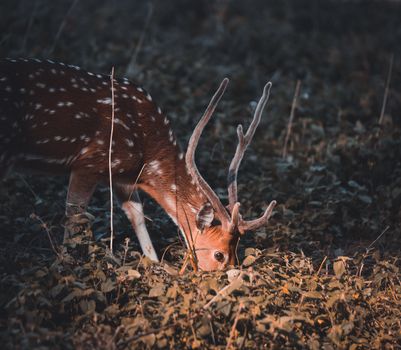
A beautiful medium-sized deer, slender and graceful. The coat is a bright reddish-fawn covered with permanent white spots and has a dark dorsal stripe. The spots on the lower flanks are arranged in longitudinal rows. Underparts, underside of tail, lower legs and throat are white. The face is buff with a darker brown muzzle. Antlers are long and beautifully lyre-shaped and normally carry three points to a side. Some antlers have additional tines, generally small and located near the junction of the brow tine and the main beam. Longest antlers of record are 44 inches (111.8 cm) (Rowland Ward, about 1877).
Taxonomy
- Kingdom
- Animalia
- Phylum
- Chordata
- Class
- Mammal
- Order
- Artiodactyla
- Family
- Cervidae
- Genus
- Axis
Habitat
Woodlands and dense riverine thickets, especially near areas with grass and water. Requires thick scrub for cover and shade. Distribution-
Diet
Essentially a grazer, but browses when grass is scarce.
Behavior
Gregarious, living in groups of 5-10, although herds of more than 100 have been seen. Some herds contain all ages and sexes, others have only females and young, or only males, and the herd composition changes constantly. As is usual with tropical deer, chital breed year-round, so there will be some males with hard antlers at all seasons. Rutting males fight frequently and furiously for females, injuring each other and breaking tines in the process. Females typically produce one fawn, sometimes two.
Hunting
Hunted by a variety of methods across its native and introduced range.
Conservation Status
Listed as Least Concern by IUCN.