
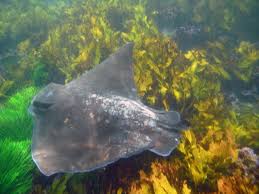
Taxonomy
- Kingdom
- Animalia
- Phylum
- Chordata
- Class
- Chondrichthyes
- Order
- Orectolobiformes
- Family
- Myliobatidae
- Genus
- Myliobatis
- Species
- australis
Habitat
This species inhabits coastal waters, estuaries, and bays with sandy or muddy bottoms, primarily in temperate regions of southern Australia and New Zealand. It prefers depths up to 50 meters where it can bury itself in the substrate for protection.
Diet
The Australian bull ray feeds mainly on benthic invertebrates such as mollusks, crustaceans, and worms, using its cephalic lobes to uncover and manipulate prey on the seafloor. It has strong jaw plates for crushing shells and typically forages during the day in shallow waters.
Behavior
Australian bull rays are generally solitary or form loose groups, actively swimming and foraging during the day while resting buried in sand at night. They exhibit territorial behavior around feeding areas and can perform impressive leaps out of the water, possibly to evade predators or dislodge parasites.
Fishing
The Australian bull ray is a prized sport fish in southern Australia and New Zealand, offering exciting challenges for anglers and supporting conservation through license fees that fund habitat protection and research. Target them using bottom fishing techniques with heavy tackle to handle their powerful runs and strength, casting bait to the seafloor and waiting for the telltale thump. Recommended tackle includes a sturdy 7-9 foot rod rated for 20-50 lb test line, a strong conventional reel, and circle hooks (size 6/0 to 10/0) to promote safe catch-and-release; use baits like fresh squid, fish pieces, or crabs to mimic their natural diet of benthic invertebrates, as lures are less effective. The best season is during warmer months from spring to summer when they are more active and foraging, with prime times being daytime hours in shallow waters up to 50 meters deep, focusing on sandy or muddy bottoms in estuaries, bays, and coastal areas of New South Wales, Queensland, South Australia, Tasmania, Victoria, Western Australia, and around New Zealand's North and South Islands. The IGFA all-tackle world record for a bull ray (Myliobatis species) stands at 145 pounds 8 ounces, caught in Australian waters, highlighting the potential for trophy catches. Conservation efforts, such as catch-and-release practices and slot limits in certain regions, are effective management tools that maintain healthy populations, with angler-funded programs in Australia and New Zealand protecting waterways and supporting stable stocks, as evidenced by its IUCN Least Concern status.
Conservation Status
Listed as Least Concern by IUCN.