
Overview
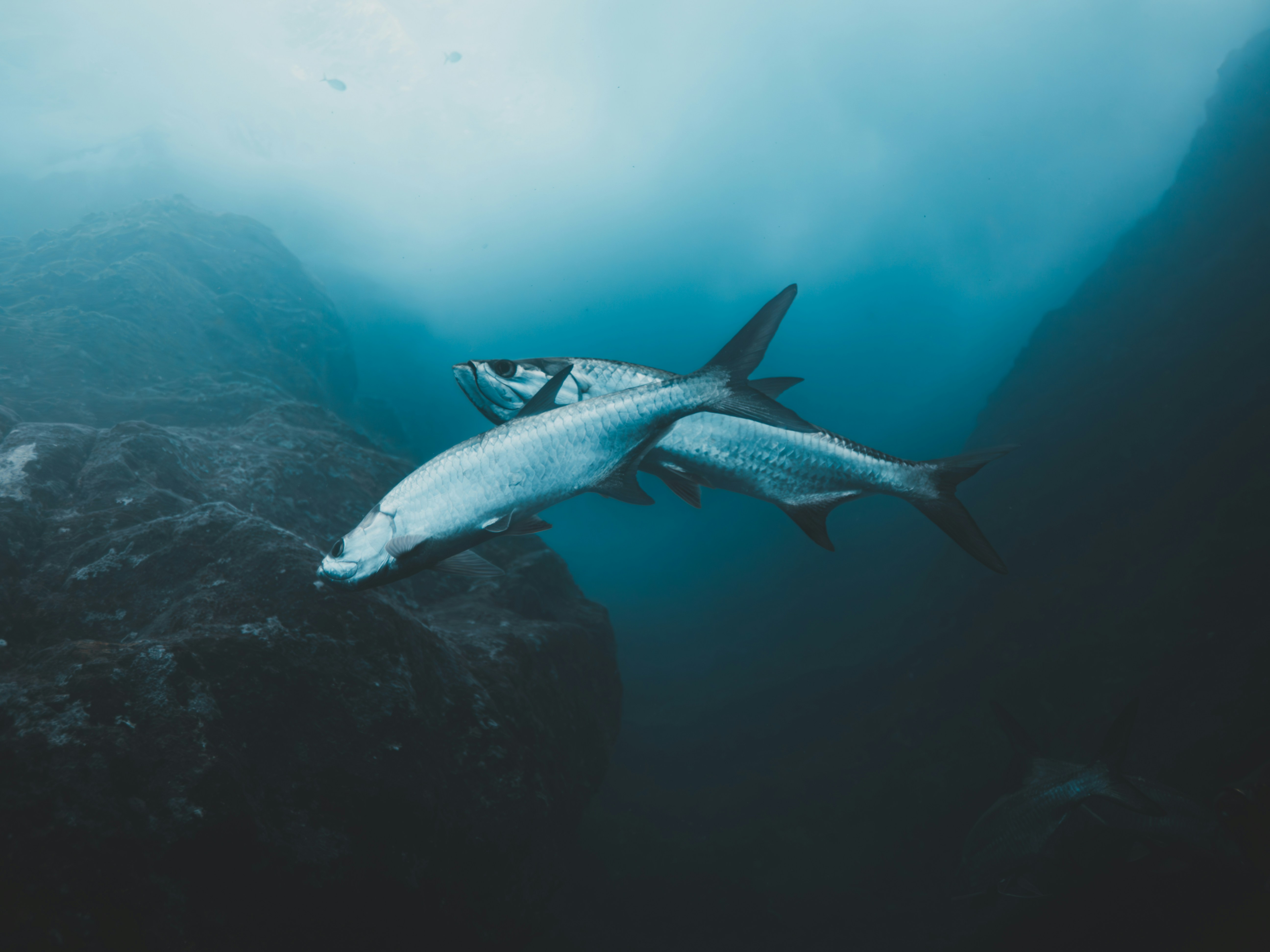
Externally, the almost vertical, silvery sides made up of large scales are the most distinctive feature of the tarpon. The tarpon has a superior mouth with the lower mandible extending far beyond the gape. The fins contain no spines, but are all composed of softrays. The dorsal fin appears high anteriorly and contains 13-15 softrays with the last ray greatly elongated into a heavy filament. The caudal is deeply forked, and the lobes appear equal in length. The anterior portion of the anal fin is deep and triangular. The fin has 22-25 softrays, with the last ray again elongated as in the dorsal fin, but shorter and only present in adults. The tarpon has large pelvic fins, and long pectoral fins containing 13-14 softrays. The synonym silver king refers to the predominant bright silver color along the sides and belly of the tarpon. Dorsally, tarpon usually appear dark blue to greenish-black. However, the color may appear brownish or brassy for individuals inhabiting inland Tarpon, bonefish, ladyfish and eels all undergo a similar leptocephalus stage, but the first three fish all have forked tails even at the larval state, whereas the eel does not.
Taxonomy
- Kingdom
- Animalia
- Phylum
- Chordata
- Class
- Actinopterygii
- Order
- Perciformes
- Family
- Megalopidae
- Genus
- Megalops
- Species
- atlanticus
Habitat
This coastal fish can be found both inshore and offshore.
Diet
Atlantic tarpon primarily feed on small fish such as mullet and menhaden, as well as crustaceans like shrimp and crabs. They are ambush predators that hunt in schools, often striking at dawn or dusk in shallow waters. Their feeding behavior includes powerful surface attacks and chasing prey over short distances.
Behavior
Atlantic tarpon are highly migratory, traveling between coastal oceans and inland estuaries, often forming large schools for protection and feeding. They are most active during low-light periods like dawn and dusk, exhibiting acrobatic jumps and powerful runs when threatened or hooked. These fish are known for their strength and endurance, making them challenging for anglers, and they can tolerate a range of salinities in both fresh and saltwater environments.
Fishing
Fishing methods are still fishing with live mullet, pinfish, crabs, shrimp, etc., or casting or trolling with spoons, plugs, or other artificial lures. The best fishing is at night when the tarpon is feeding. They are hard to hook because of their hard, bony mouths. Once hooked they put up a stubborn and spectacular fight, often leaping up to 10 feet out of the water. It was one of the first saltwater species to be declared a game fish.
Conservation Status
Listed as Vulanerable by IUCN.