
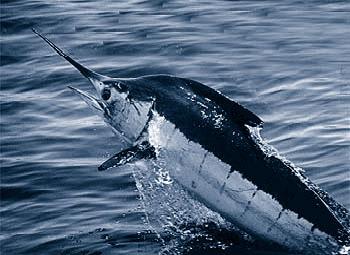
Overview
Japanese longliners report that the blue marlin is the largest of the istiophorid fishes. It apparently grows larger in the Pacific. All giant marlins are females, and male blue marlin rarely exceed 300 lb (136 kg). The pectoral fins of blue marlin are never completely rigid, even after death, and can be folded completely flat against the sides except in the largest specimens. The dorsal fin is high and pointed anteriorly (rather than rounded) and its greatest height is less than the greatest body depth. The anal fin is relatively large and it too is pointed. Juveniles may not share all the characteristics listed above, but the peculiar lateral line system is usually visible in small specimens. In adults it is rarely visible unless the scales or skin are removed. The vent is just in front of the anal fin, as it is in all billfish except the spearfish. The back is cobalt blue and the flanks and belly are silvery white. There may be light blue or lavender vertical stripes on the sides, but these usually fade away soon after death, and they are never as obvious as those of the striped marlin. There are no spots on the fins.
Taxonomy
- Kingdom
- Animalia
- Phylum
- Chordata
- Class
- Actinopterygii
- Order
- Perciformes
- Family
- Istiophoridae
- Genus
- Makaira
- Species
- nigricans
Habitat
Atlantic blue marlin primarily inhabit open ocean pelagic waters in tropical and subtropical regions, often at depths from the surface to several hundred meters. They prefer warm waters above 24°C and are commonly found near continental shelves, oceanic fronts, or around floating debris that attract prey. Their range extends across the Atlantic, Indian, and Pacific Oceans, with seasonal migrations following food sources and water temperatures.
Diet
They are known to feed on squid and pelagic fishes, including blackfin tuna and frigate mackerel.
Behavior
Seasonal concentrations occur in the southwest Atlantic (5°-30°S) from January to April; in the northwest Atlantic (10°-35°N) from June to October; in the western and central North Pacific (2°-24°N) from May to October; in the equatorial Pacific (10°N-10°S) in April and November; and in the Indian Ocean (0°-13°S) from April to October.
Fishing
A powerful, aggressive fighter, they run hard and long, sound deep, and leap high into the air in a seemingly inexhaustible display of strength. Fishing methods include trolling large whole baits such as bonito, dolphin, mullet, mackerel, bonefish, ballyhoo, flying fish and squid as well as various types of artificial lures and sometimes strip baits.
Conservation Status
Listed as Vulnerable by IUCN.