
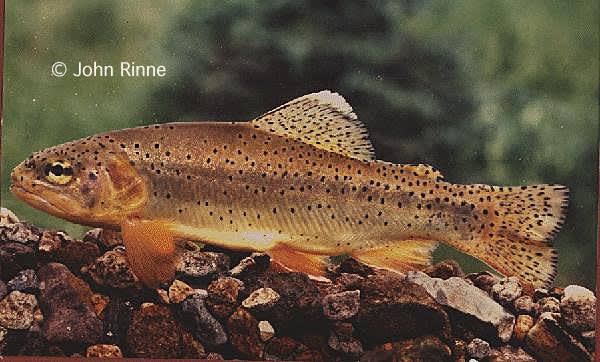
Taxonomy
- Kingdom
- Animalia
- Phylum
- Chordata
- Class
- Actinopterygii
- Order
- Perciformes
- Family
- Salmonidae
- Genus
- Oncorhynchus
- Species
- apache
Habitat
Apache trout primarily inhabit clear, cold streams and rivers in the high-elevation mountains of east-central Arizona, such as the Upper Salt River and Little Colorado River drainages. They prefer habitats with gravel or rocky substrates, deep pools, and riffles, requiring well-oxygenated water with temperatures below 20°C to thrive. These areas are often in forested or canyon terrains that provide shade and cover.
Diet
Apache trout mainly feed on aquatic insects such as mayflies, caddisflies, and midges, as well as terrestrial insects that fall into the water. They also consume small fish, crustaceans, and occasionally amphibians, exhibiting opportunistic feeding behavior primarily during dawn and dusk in slower-moving pools or riffles.
Behavior
Apache trout are generally solitary and territorial, particularly when defending spawning sites or feeding areas in streams. They are most active in cooler water temperatures, often hiding under rocks or in undercut banks during the day and becoming more mobile at night or in low-light conditions. These fish exhibit schooling behavior in juveniles but become more solitary as adults.
Fishing
Anglers targeting the Apache trout, a prized sport fish in Arizona's high-elevation streams, should focus on fly fishing techniques using dry flies, nymphs, or small streamers to mimic their primary diet of aquatic insects like mayflies and caddisflies; cast upstream into deep pools, riffles, and runs in clear, cold waters of the Upper Salt River, Little Colorado River, and other Colorado River drainage areas, retrieving slowly to entice strikes during dawn and dusk when these fish are most active. Use lightweight tackle such as a 4-6 weight fly rod with a 7.5 to 9-foot leader and 4-6 lb tippet for precision and minimal impact, paired with flies in sizes 12-18 to match local hatches; avoid live bait to reduce stress on this sensitive species. The best seasons are spring and fall when water temperatures are below 20°C, offering optimal feeding windows in these shaded, forested or canyon habitats. Record sizes include a maximum length of 22 inches and weight up to 5 pounds 3 ounces, with the IGFA all-tackle world record for Apache trout at 5 pounds 3 ounces caught in Arizona in 2013. As a Critically Endangered species, fishing for Apache trout is managed through effective tools like catch-and-release only regulations and closed seasons in certain areas, which are supported by angler-funded programs through license fees that bolster habitat restoration and stocking efforts, ensuring healthy populations and demonstrating how regulated recreational fishing directly contributes to their conservation in Arizona's waterways.
Conservation Status
Listed as Critically Endangered by IUCN.