
Overview
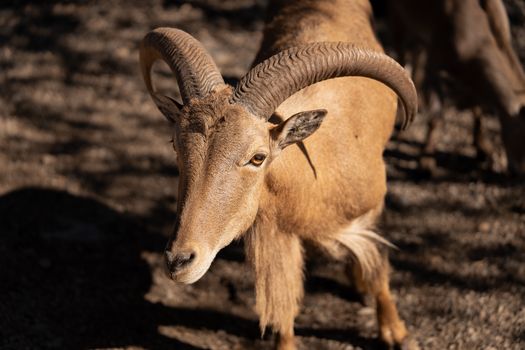
The Aoudad is a medium-sized mountain animal that is biologically intermediate between a goat and a sheep. It is strongly built, with a short mane on neck and shoulders and long flowing hair on throat, chest, forelegs and tail. The general color is sandy brown, with underparts paler. As in goats, the aoudad has a scent gland beneath the tail, but does not have glands between the hoofs, in the groin area or in front of the eyes. The horns (both sexes) are sheep-like, being smooth, thick, triangular in section, and curved to form a semi-circle over the neck (supracervical horns). Females are much smaller than males and lighter in color, with less hair and much smaller horns.
Taxonomy
- Kingdom
- Animalia
- Phylum
- Chordata
- Class
- Mammal
- Order
- Artiodactyla
- Family
- Bovidae
- Genus
- Ammotragus
Habitat
Barbary sheep live in the desert mountains from sea level up to the edge of the snows. Distribution- Native to the desert mountains in the Sahara region of northern Africa. Desert hills and mountains of northern Africa from Morocco and Mauritania eastward to Libya and Chad. Also in northeastern Sudan. Thought to be extinct in Egypt. Has been introduced on private ranches in South Africa, which is far outside its natural range, and also in Spain, Mexico and the United States. Free-ranging in parts of Texas, New Mexico, California and Mexico. Also on private properties, mainly in Texas, but also in a number of other U.S. states. Native to the desert mountains in the Sahara region of northern Africa. In 1924, aoudad were released on the Hearst Ranch-mostly unfenced-in San Luis Obispo County, California, and have since populated nearby areas, where they have been hunted without legal protection. Introduced in 1950 in the Canadian River Canyon in New Mexico by the state game department, with hunting by drawn permit. Some of these animals have wandered as far as Colorado and Oklahoma. Also found in the wild in southeastern New Mexico, mainly as the result of escapes from private enclosures. Occurs in the wild in Palo Duro Canyon south of Amarillo, Texas, as a result of state-sponsored releases, also elsewhere in Texas from private releases. Released in the wild in several places in Mexico.
Diet
Eats grasses and foliage, sometimes standing on its hind legs to browse. Drinks water where available, otherwise obtains moisture from its food. Feeds in the early morning and late afternoon.
Behavior
Will descend from rocky terrain in evening to feed on plains. Eyesight and hearing are very good, sense of smell is good. An agile climber and jumper. Usually lives in small family groups with an adult male. Old males and pregnant females may be solitary. Breeds mainly from September to November, but there is some activity throughout the year. A single offspring (often twins) is born 5-1/2 months later. Newborns are able to get about in moderately rugged terrain almost at once, and are sexually mature at about 18 months. Females have been known to give birth twice annually. Captives have lived as long as 20 years. They can be found resting during the day.
Hunting
These animals are very tough and hardy. The aoudad is difficult to hunt under almost any circumstances even within a game fence. The Ovis World Slam recognizes the aoudad wherever found, and further encourages the hunting of this highly desirable trophy species.
Conservation Status
The aoudad may never have been common in northern Africa because of its limited habitat in the desert environment. In recent years, its numbers have been reduced in many places from poaching, overharvesting, and competition with domestic livestock and feral camels. To the best of our knowledge, Chad and Sudan are the places it can be hunted today in its natural range.