
Overview
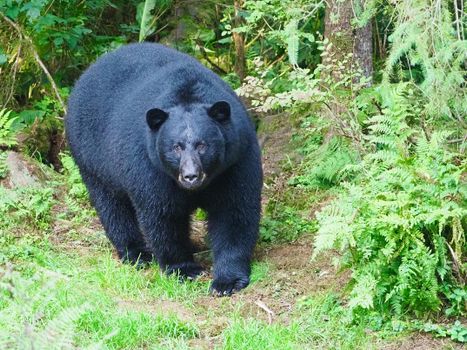
The smallest North American bear, its name refers to the most common color phase, which is a uniform black with a brown muzzle and often a splash of white on the chest. Other color phases, which usually occur in western parts of North America, vary through several shades of brown to a pale cinnamon. Several color phases can occur in the same geographic area or even in the same litter. The so-called glacier bear (given the subspecific name emmonsii by Dall in 1895) is a rare bluish-gray color phase that occurs only near Yakutat, Alaska, where it provides limited hunting opportunities. Rarest color phase is the all-white (but not albino) Kermode bear (named kermodei by Hornaday in 1905) found only on islands off the northwest coast of British Columbia and protected by law. These are now regarded as color phases only; neither emmonsii nor kermodei is considered a valid subspecies today. Compared to a brown or grizzly bear, a black bear's back is straight instead of humped, its nose is pointed, its profile is straight, its ears are large and erect, its claws are much shorter and more curved, and the hairs of its coat are shorter.
Taxonomy
- Kingdom
- Animalia
- Phylum
- Chordata
- Class
- Mammal
- Family
- Ursidae
- Genus
- Ursus
Habitat
Mainly forest and woodland at all elevations. Unlike the grizzly, it is able to coexist with humans and is commonly found near large metropolitan areas. As Grizzly bear range shrinks from expanding civilization, that of the black bear expands to occupy the vacated areas. Distribution- All of Alaska and Canada except the high arctic and the west coast; much of the western United States, extending into Mexico; throughout the Great Lakes region, New England, Appalachia and the Ozarks; also in Florida and adjacent Gulf Coast areas.
Diet
Omnivorous: plants, fruits, nuts, insects, honey, salmon, small mammals and carrion. In northern regions, they eat spawning salmon.
Behavior
Like other bear species, the black bear is solitary except when mating, or when a sow is with her cubs. It is territorial, tending to avoid others even where territories overlap. Will congregate at a common food source, such as a garbage dump or berry patch, but even so will stay out of each other's way. Mating season is June and July. The female usually gives birth in alternate years, mainly in January and February, with 2-3 cubs being born in the den. Cubs stay with the mother 1-1/2 years, sometimes 2-1/2 years. Dens during the winter in colder regions, but may not do so in warmer southern areas. A fast runner, able to maintain 25 mph (40 kmh) for a long distance. An excellent tree climber-the only North American bear that, as an adult, can still climb trees. A powerful swimmer. Senses of smell and hearing are very good, eyesight is adequate. Intelligent, shy, secretive and yet inquisitive. Generally harmless to man except when wounded or protecting its young; however, attacks on humans-with some fatalities-occur with some regularity, especially in closed hunting areas.
Hunting
One of North America's most common and adaptable big game animals. Many black bears are probably bagged as targets of opportunity while hunting other game, such as deer. Also hunted by baiting (where lawful), with the hunter concealed nearby in a blind or tree stand (this is the method favored by bow-hunters). For bait, some experts prefer bakery goods-especially sweets-instead of traditional slaughterhouse offal or fish. But probably the surest hunting method is by trailing with a pack of hounds (where lawful).
Conservation Status
This animal is listed as Least Concern by IUCN. The American black bear is the only bear endemic to North America and has the largest population of any bear in the world.