
Overview
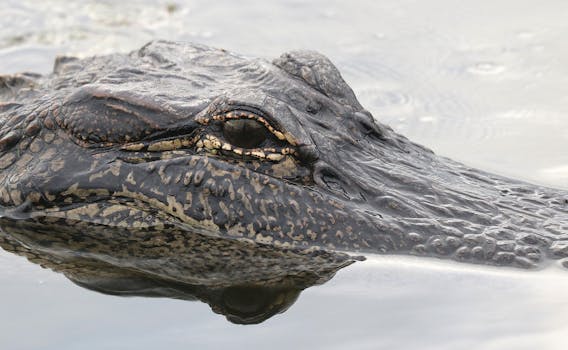
The American alligator is a lizard-like reptile with a heavy, cylindrical body; large, triangular head; powerful jaws with many conical teeth; short legs with clawed, webbed toes; long massive tail; and thick plated skin (flat plates on belly, keeled plates on back). Eyes, ears and nostrils are on top of the head and can project above water when the rest of the body is submerged. When under water, the nostrils and ears close, a third eyelid protects the eyes, and a flap of skin closes off the back of the mouth, allowing the alligator to eat under water without drowning. Differs from crocodiles in having a shorter, broader snout, with the teeth of the lower jaw fitting inside those of the upper jaw, thus not visible when the mouth is closed. Juveniles are black with yellow bands; adults are a grayish-black all over.
Taxonomy
- Kingdom
- Animalia
- Phylum
- Chordata
- Class
- Reptile
- Order
- Crocodilia
- Family
- Alligatoridae
- Genus
- Alligator
Habitat
Marsh-bordered lakes and coastal marshes, both freshwater and brackish.
Diet
Feeds mainly on fish, small animals birds, and domestic pets, but sometimes takes larger mammals as well.
Behavior
Carnivorous, mostly nocturnal, and amphibious. Spends most of its time in the water; however, is known to take rather long overland journeys, and during the day will often sun itself at water's edge, sometimes in large numbers. Otherwise solitary, with individual territories. Digs burrows for shelter. Able to endure colder winters than other alligators/caimans and most crocodiles. A mound-nesting species, with the female building a mound of mud and vegetation in which her eggs (usually 20-70) are buried. The male roars loudly, and both sexes hiss. Usually avoids humans, but attacks (sometimes fatal) do occur. Crocodilians have the most highly developed brains of all reptiles; they often show curiosity and are capable of being tamed to a certain extent.
Hunting
The states of Florida, Georgia, Alabama, Arkansas, Mississippi, Louisiana, South Carolina, and Texas all distribute alligator hunting licenses. North Carolina is the only state in the alligator's range which prohibits hunting. Depending on the state, hunters can use the following methods: hook and line, bow and arrow, gig and snare and firearm. The use of a hook and line is the most common method. It involves securing a sturdy hook and line to a tree or pole in the ground. The hook is commonly baited with fish or chicken quarter. After the bait is taken, the hunter returns to draw in and dispatch the gator. Allowed methods of hunting vary by state, in South Carolina an alligator must be captured before being killed with either a handgun or bangstick. A bangstick is a specialized underwater firearm fired only when in direct contact with the target.
Conservation Status
Listed as Least Concern by IUCN. Severely depleted in the 1950s from loss of habitat, commercial hide-hunting, and persecution as a pest. Since then, protective measures have allowed excellent recovery (for example, in Louisiana from 26,000 in 1957 to over 300,000 in 1982). Total population (1982) about 800,000. This species was listed as Endangered in the Endangered Species Act in 1973 before the population rebounded and is now listed as Least Concern by IUCN.