
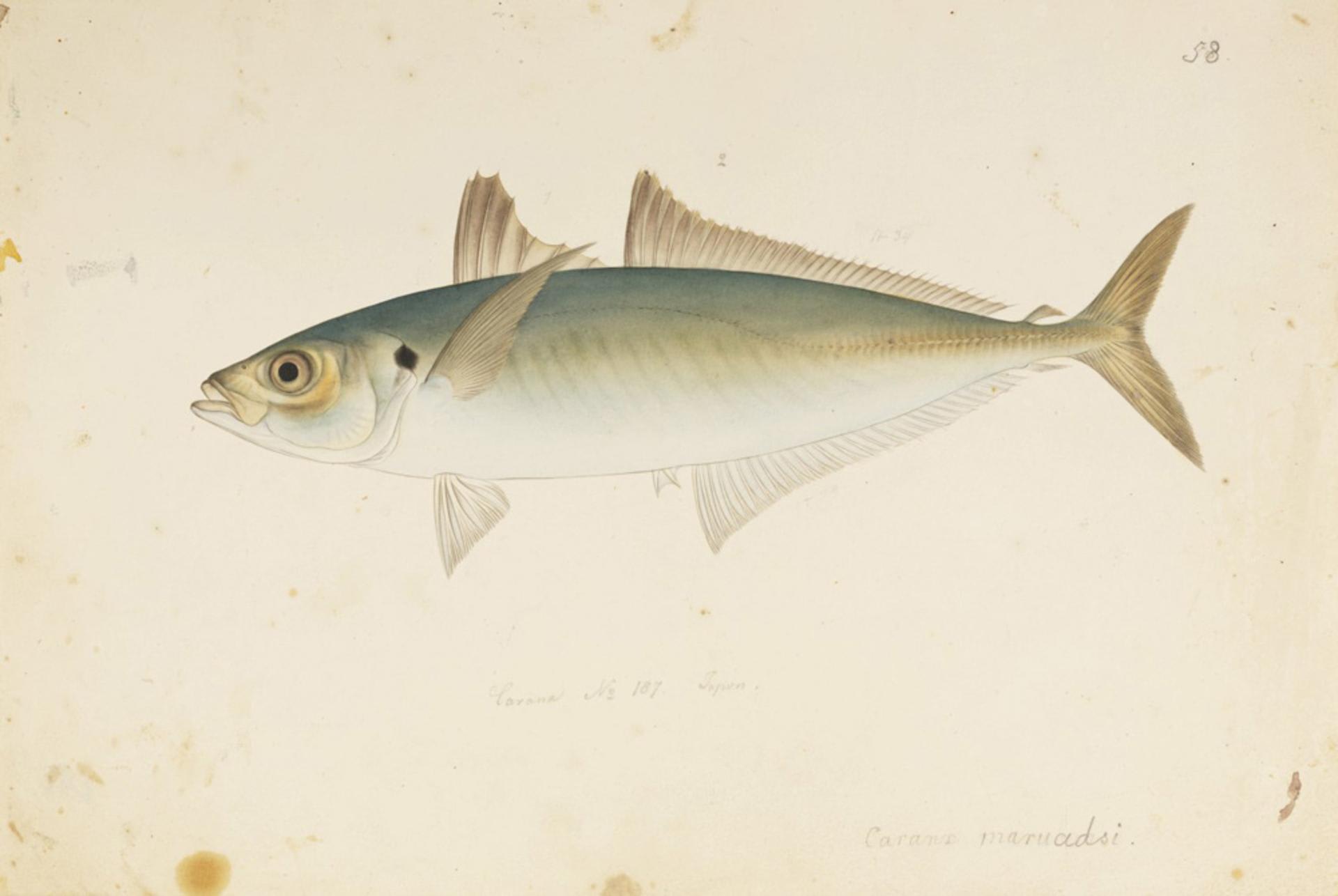
Taxonomy
- Kingdom
- Animalia
- Phylum
- Chordata
- Class
- Actinopterygii
- Order
- Cichliformes
- Family
- Carangidae
- Genus
- Decapterus
- Species
- maruadsi
Habitat
Amberstripe scad inhabit open pelagic waters of the Indo-West Pacific, including coastal and offshore areas around Hawaii, the South China Sea, and the Mariana Islands. They prefer depths from 50 to 200 meters over continental shelves and are commonly found in warm, tropical to subtropical seas. These fish avoid very shallow or extremely deep waters.
Diet
Amberstripe scad primarily feed on small fish, shrimp, and other crustaceans, which they capture in mid-water columns. They are visual predators that hunt in schools during the day, often targeting planktonic organisms and smaller prey. Feeding activity peaks in the morning and evening when prey is abundant.
Behavior
Amberstripe scad form large, tightly packed schools for protection and efficient feeding, which helps them evade predators. They are diurnal, actively swimming and foraging during the day while resting in deeper waters at night. These fish exhibit migratory patterns following food sources and seasonal changes, and they show little territorial behavior.
Fishing
Anglers targeting the Amberstripe scad, a popular pelagic species in the Indo-West Pacific including Hawaii, the South China Sea, and the Mariana Islands, should focus on trolling or jigging techniques to mimic their schooling behavior and pursuit of small prey; use light to medium spinning or trolling rods with 10-20 pound test line, paired with reels that handle fast retrieves, and opt for lures like small metal jigs, spoons, or soft plastics that imitate shrimp and small fish, or live bait such as sardines or shrimp for greater success. The best season is during warmer months from spring through fall when spawning peaks and fish are more active, with prime times being early morning or late evening when feeding activity is highest in the mid-water columns; target them in open offshore waters at depths of 50 to 200 meters over continental shelves, using fish finders to locate schools. Record sizes reach up to 40 cm (about 16 inches) and 2 pounds 8 ounces, with no specific IGFA all-tackle record noted, but these fish offer exciting light-tackle fights. As a key species in recreational fisheries, regulated angling supports conservation by funding habitat protection through license fees and excise taxes, ensuring sustainable populations; while not evaluated by IUCN, anglers are encouraged to practice catch-and-release for smaller fish to maintain healthy stocks and support broader marine ecosystem programs in these tropical waters.
Conservation Status
Listed as Not Evaluated by IUCN.