
Overview
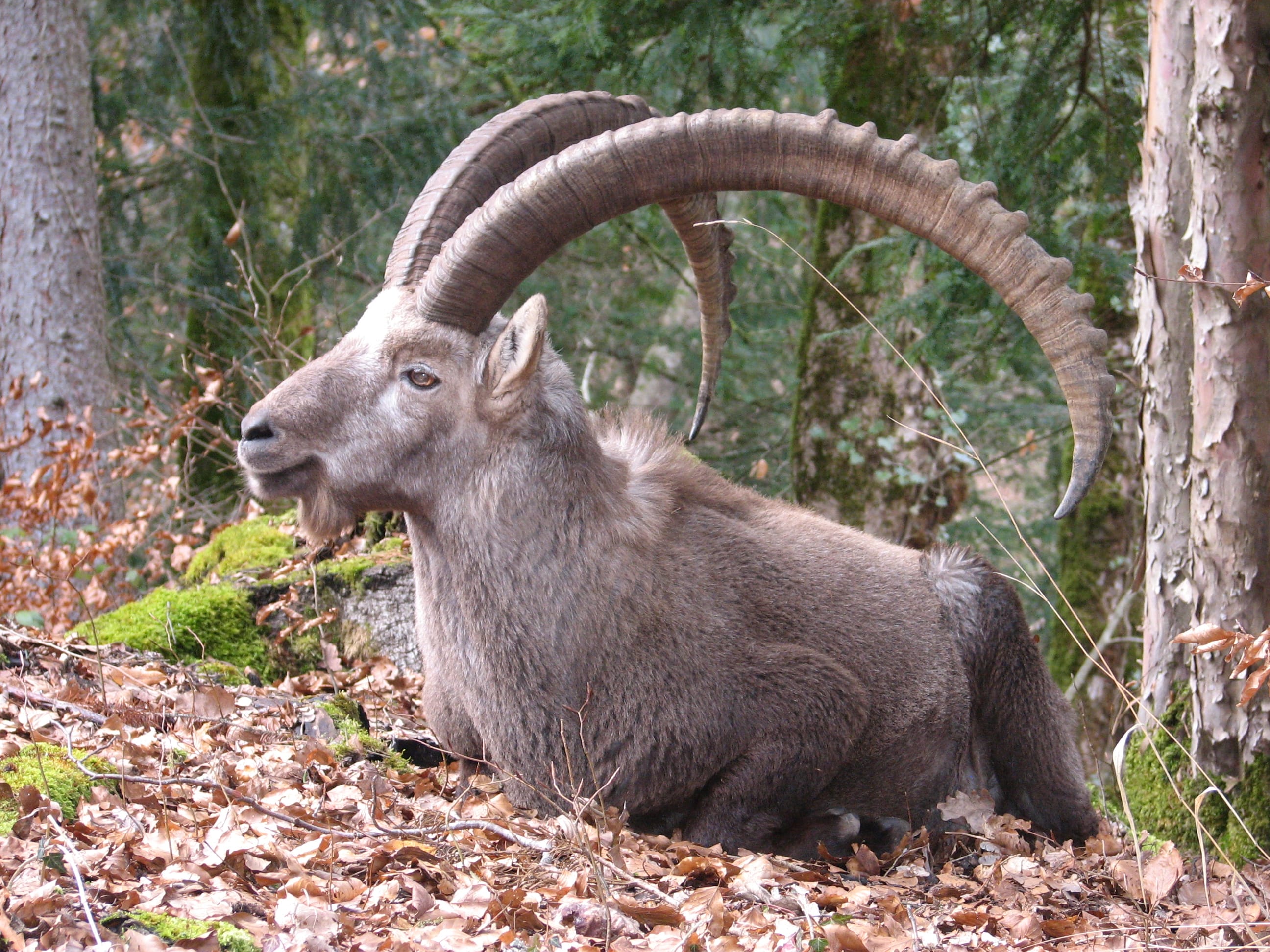
The Alpine ibex is a stocky animal, darker in color than other ibexes. The upper parts are a uniform grayish-brown (lighter in summer and darker in winter), separated from the pale underparts by a darker brown band. The legs, upper surface of tail and forehead are also a darker brown. Males have a small beard and large, impressive horns that are shorter, thicker and straighter than those of other ibexes. Females have very small horns and no beard.
Taxonomy
- Kingdom
- Animalia
- Phylum
- Chordata
- Class
- Mammal
- Order
- Artiodactyla
- Family
- Bovidae
- Genus
- Capra
Habitat
High mountains, normally above the treeline and at or below the snowline. Ibexes evolved in arid mountains with little snow, and were never widely distributed in the Alps. Good ibex range is limited to mountains with little precipitation and with sunny, snow-free areas where the animals can survive the winter. Distribution- Originally throughout the Alps and also in other European mountains, but became extinct except in the Piedmont region of northwestern Italy. Free-ranging populations have since been re-established elsewhere in Italy, and also in Switzerland, Austria and adjacent parts of France, Germany and Slovenia. Once again numerous in some areas, with the largest populations in Switzerland. Also reintroduced in 1901 in the High Tatra Mountains on the borders of Slovakia and Poland, where they are said to have hybridized with subsequently introduced Nubian ibex and bezoar ibex; however, these animals appear to have died out. Outside Europe, Alpine ibexes have been introduced on private properties in Argentina and elsewhere.
Diet
Feeds mostly on grasses, but also eats shrubs and lichens.
Behavior
Gregarious, with females and young in small herds, and males solitary or in small bachelor groups. Mates in December, with one (sometimes two) kids born in the spring. Very agile and surefooted on steep terrain.
Hunting
Alpine ibex are available to foreign hunters in Austria and Slovenia, and in Switzerland by special permit. When free-ranging, they offer excellent sport and are one of Europe's most prestigious big game animals because of their relative scarcity, the difficult terrain they inhabit, and the quality of the hunting experience. They also can be collected on fenced private properties where they often grow better horns than those of free-ranging animals; however, the quality of the hunting experience may not be the same.
Conservation Status
Listed as Least Concern by IUCN.