
Overview
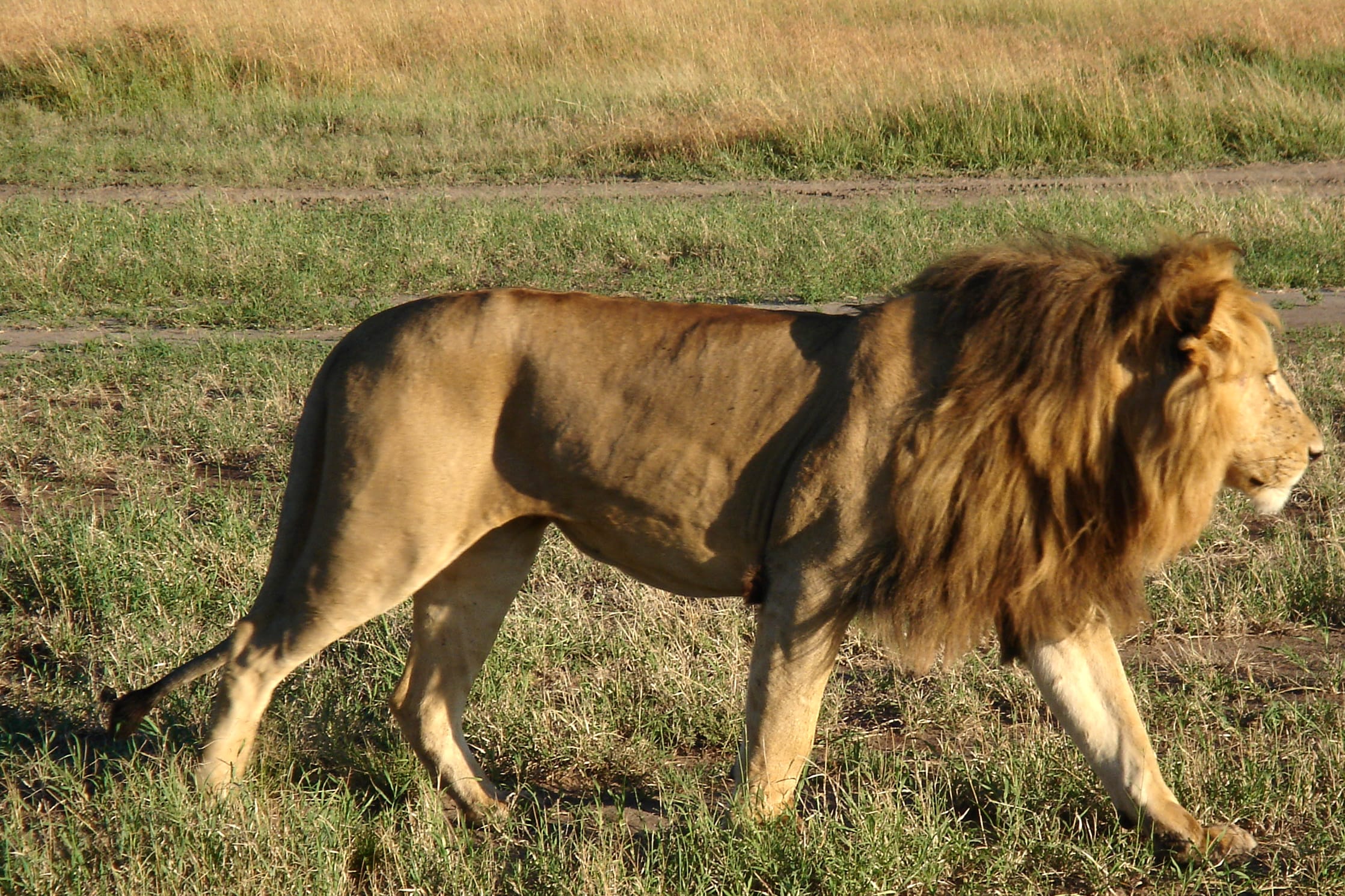
The lion is the largest cat in Africa and, among the world's cats, is second in size only to the tiger. The smooth short coat is usually tawny beige in color, but can vary from light gray to dark reddish brown. The end of the tail has a black tuft, and there are black markings on the backs of the ears. There are five toes (including dewclaws) on the front feet, four on the hind feet, all with sharp, curved, retractile claws. The male usually has a mane of long hairs on its head, shoulders and chest, but there is much variation, with some individuals having magnificent manes and others being nearly bald, and the color varying from blond to black. Besides being considerably smaller than males, females are more lightly built and lack a mane.
Taxonomy
- Kingdom
- Animalia
- Phylum
- Chordata
- Class
- Mammal
- Order
- Carnivora
- Family
- Felidae
- Genus
- Panthera
- Species
- Panthera leo
Habitat
Grassland, bush and savanna woodland. Rarely in dense forest. Distribution- Widespread throughout Africa from south of the Sahara to northern Namibia, Botswana and parts of South Africa.
Diet
Lions are entirely carnivorous, their usual prey consisting of warthogs, antelopes and zebras in the 100-650 lbs range (45-300 kg), though larger species such as buffalo and giraffe are also taken. Will eat carrion. An individual lion can eat as much as 80-90 lbs (36-41 kg) of meat at one meal, and is estimated to require 10-20 large prey animals per year. May prey on cattle and other livestock, and some lions become man-eaters. Drinks daily when water is available, but can subsist without water for long periods by obtaining moisture from its prey.
Behavior
Lions are the most social of all cats and usually are found in family groups, or prides, consisting of related females and their young plus one or more adult males. Adult males often form small bachelor groups. Seldom solitary. Each group has a large home range. Not territorial. Breeding takes place throughout the year, although in any one pride the females tend to deliver offspring at about the same time. A female normally gives birth every 18-26 months, with 3-4 cubs the usual number (the range is 1-6). Cubs are sexually mature at 3-4 years, but continue to grow until about age six. Lions spend most of the time resting and sleeping, averaging 20 or more hours of inactivity a day. Activity may occur at any hour, but their hunts take place mainly at twilight and night. Sense of smell is good, hearing and eyesight are excellent. Its voice is the well-known roar, which is heard mainly at night and is audible for miles. Able to run 40 mph (65 kmh) for a short distance. A poor tree-climber.
Hunting
A lion is a highly esteemed hunting trophy and taking a good one is a major event for both client and safari staff. The usual hunting methods are by baiting or tracking; however, many lions are taken by chance encounter. Lions can be extremely dangerous when wounded or provoked, especially if other members of the pride become involved. Trophy quality is determined largely by the mane, although size of body and skull are also important. Because a lion's Record Book score is the sum of its skull measurements, skull size is of primary importance to anyone seeking a high ranking. Unfortunately, a large-bodied, large-skulled lion can have a poor mane, and vice versa. The ideal combination of a full mane of whatever color the hunter prefers, a large body and a large skull is difficult to find and often necessitates a number of safaris. An unfortunate consequence is the setup or canned lion hunt, in which a captive lion is presented to an unsuspecting client. Such a hunt can be impossible for the client to detect if well-orchestrated. Since the beginning, SCI has had a policy against accepting setup lions for the Record Book, and has never knowingly done so.
Conservation Status
Listed as Vulnerable by IUCN. The Lion population is inferred to have undergone a reduction of approximately 43% over the past 21 years (approximately three Lion generations, 1993-2014). We infer a decline of 43% based on time trend analysis of census data for 47 relatively well monitored Lion subpopulations. These subpopulations approximately totalled an estimated 7,500 Lions in 2014 and comprise a substantial portion of the total species population, so that we feel confident in applying observed trends to the species as a whole as well as on a regional basis. The overall classification of the Lion as Vulnerable masks a dichotomy: we observe that sample Lion subpopulations increased by 12% in four southern African countries (Botswana, Namibia, South Africa and Zimbabwe) and in India, while an observed decline of 60% in sample subpopulations outside these countries is inferred for the remainder of its African range. In other words, in the majority of its range the Lion meets the A2 criterion for Endangered with the inferred rate of decline over 50% in three generations, but this trend is numerically mitigated by a small number of subpopulations in a restricted geographical range. This dichotomy is reflected in listings of the species in different Red Lists: in South Africa, the Lion will be categorized as Least Concern on the national Red List in preparation (Child et al. In prep.), whereas in India it is Endangered (as subspecies P. l. persica on the global IUCN Red List: Breitenmoser et al. 2008) and in the region of West Africa meets the criteria for Critically Endangered (Henschel et al. 2014, 2015). The range state list in Table 1 (attached Supporting Material) further illustrates the high threat levels across the species’ broad geographic range, as Lions have been recently extirpated in 12 African countries and we suspect possible recent extirpation in another four. Among the causes of decline, the most important are indiscriminate killing in defence of human life and livestock, habitat loss, and prey base depletion. Prey base depletion is partly linked to habitat loss, but more importantly to poaching and bushmeat trade (Becker et al. 2013). An emerging threat is trade in bones and other body parts for traditional medicine, both within Africa and in Asia (IUCN 2006a, b; Riggio et al. 2013). Furthermore, although trophy hunting contributes positively to Lion conservation, improvements in management practices have been recommended (Lindsey et al. 2013b, Hunter et al. 2013, Edwards et al. 2014), as when poorly regulated, it also contributes to population declines (Packer et al. 2009, 2011; Croes et al. 2011, Rosenblatt et al. 2014). While attention is currently focused on Lion hunting reforms to ensure sustainability, the leading causes of population decline are more difficult to address and are likely to continue. The observed and inferred reductions are based on direct observation; appropriate indices of abundance; declines in area of occupancy, extent of occurrence and habitat quality; and actual and potential levels of exploitation. Several subpopulations have been stable, among them the only remaining subpopulation in Asia (surviving in the Gir Forest area of Gujarat, India) and several subpopulations in southern Africa. Subpopulations appear to be stable where management is properly funded; fencing is one of several effective conservation management techniques (Packer et al. 2013). However, many Lion subpopulations occur in areas where management budgets are low, leading to local decline and even extinction, for example in West Africa (Henschel et al. 2014). Little is known about Lion subpopulations in Angola, Central African Republic and South Sudan, but we fear drastic declines especially for the latter two. In conclusion, we assess the Lion as Vulnerable based on criterion A, more specifically A2abcd. Lion range and abundance exceed the Vulnerable thresholds for criteria B, C and D, respectively, so these criteria do not contribute to the present assessment, whilst criterion E was not applied. Vulnerable A2abcd is the same listing as the previous assessment but with a different underlying method. Previous assessments were based on a suspected decline of the total estimated number of Lions, which necessarily included low quality data. In the present assessment we did not use total Lion estimates, because we had a better alternative. We now have enough good quality data for a representative sub-set of Lion subpopulations to calculate an observed decline, from which we infer a decline for the species as a whole. (IUCN)