
Overview
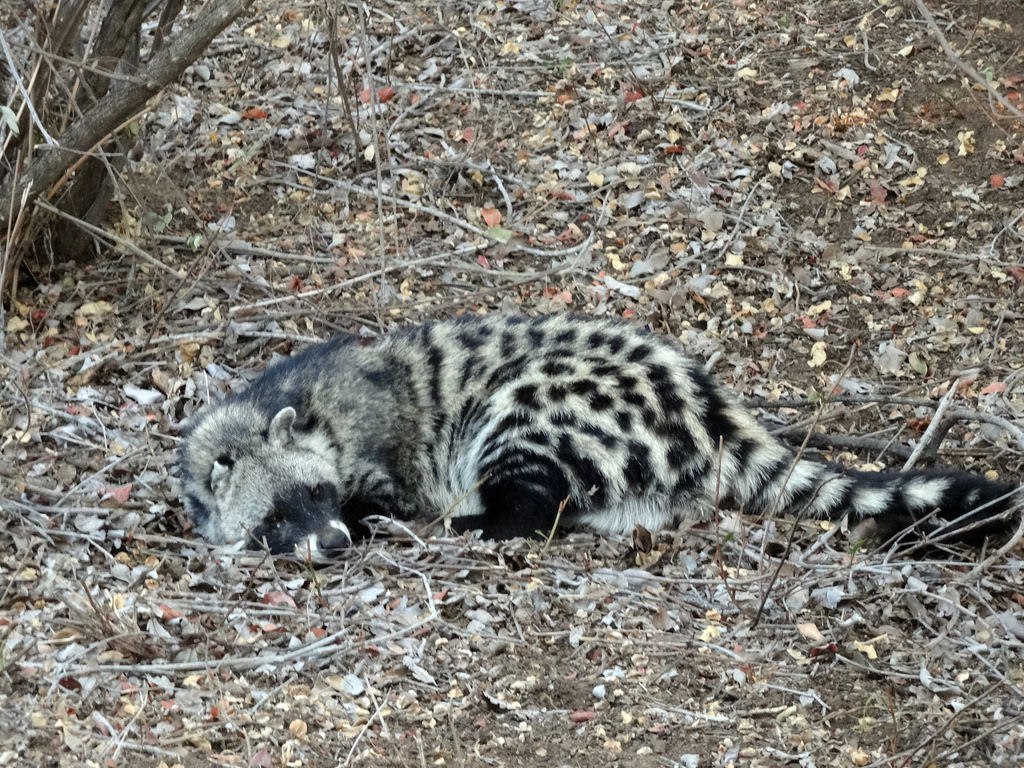
The African civet is much larger than any other viverrid. There is a great deal of individual variation in color pattern, with no two animals exactly alike, but, in general, the lower legs are black, there is a black band across the face, the nose is black with white around it and the forehead is gray. The ears are whitish inside, black at the base outside, and have white tips. The body has a distinct pattern of black spots and stripes on a grayish or whitish background. The long, bushy tail has broad black bands and a black tip. The coat is long and coarse, especially on the upper parts where it can be erected to form a spectacular crest from forehead to tail when threatened. The legs are short, the head elongated, the muzzle pointed, and the ears small and rounded. All feet have five toes and hairy soles. There are large scent glands under the tail that contain an oily substance used in making perfume. This substance, known as civet, can be spooned out without harming the animal, thus captive African civets have supplied musk to the perfume industry for thousands of years. The trade in civet musk continues to this day, especially from Ethiopia, even though it has been largely replaced now by synthetics.
Taxonomy
- Kingdom
- Animalia
- Phylum
- Chordata
- Class
- Mammal
- Family
- Viverridae
- Genus
- Civettictis
Habitat
Savanna and forest where there is daytime cover, nearby water, and sufficient food. Distribution- Throughout Africa south of the Sahara except for the southwestern arid zone.
Diet
The African civet has a broad diet and will eat almost anything. Diet includes small mammals, terrestrial birds, invertebrates, insects and vegetable matter.
Behavior
Usually solitary, although family groups of an adult and one or more young have been observed. Believed to be territorial, with boundaries well-marked by scent glands. Mostly silent, communicating more with scent glands than with vocalization. Mating is believed to take place throughout the year. There may be as many as 2-3 litters in a year, usually with 2-3 young (range is 1-4) per litter after a gestation period of 60-72 days. Sexual maturity is attained at about one year. Mostly nocturnal and terrestrial, as it climbs trees poorly. Not a fast runner but is agile and elusive. Swims well. Scent seems to be of primary importance,and hearing is also acute, but appears to be short-sighted. Tends to move slowly along established paths with its rump held high, its head low, and its nose close to the ground. When disturbed, usually flattens or stands motionless, relying on its camouflage to avoid detection.
Hunting
These animals are often hunted by opportunity while hunting for other animals. Countries which allow civet hunting include the following: Cameroon, Central African Republic, Tanzania, Namibia, South Africa, Zimbabwe, and Zambia. Until 2010, these animals also could be hunted in Mozambique.
Conservation Status
Listed as Least Concern by IUCN.