
Overview
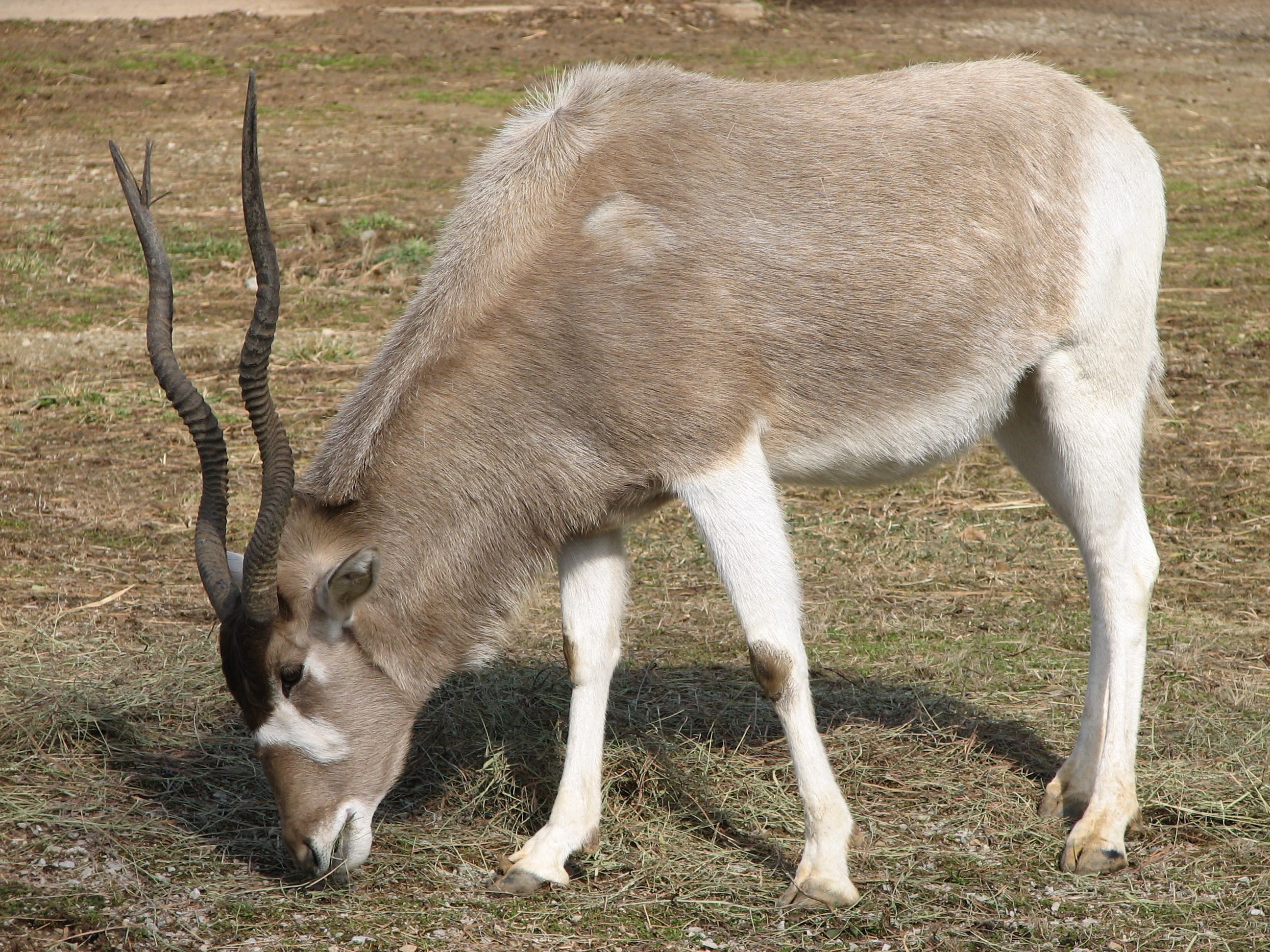
The addax is a medium-sized antelope of stocky build, with long, spiral horns. Overall color is a sandy gray with white underparts and legs. There is a brown patch on the forehead and a white patch across the muzzle in front of the eyes. The tail is fairly long with a black tuft. The hoofs are much enlarged for walking on desert sands. Both sexes grow horns, which are prominently ringed, spirally twisted (up to three turns), and divergent. Females are somewhat smaller than males and have thinner, shorter horns, but are otherwise similar.
Taxonomy
- Kingdom
- Animalia
- Phylum
- Chordata
- Class
- Mammal
- Order
- Artiodactyla
- Family
- Bovidae
- Genus
- Addax
Habitat
True desert. Distribution- Remnant populations survive in remote parts of the Sahara Desert, specifically Niger and Chad. Has also been introduced to private ranches in Texas.
Diet
Grasses and desert plants.
Behavior
Usually in herds of 5-20 animals led by an old male. Sometimes in much larger herds during migrations following the rains. Highly nomadic, addax travel long distances in search of suitable food. Their migrations are north and south (those of scimitar-horned oryx are east and west). The most desert-adapted of antelopes, addax apparently are able to sense changes in humidity and find places where rain has fallen or vegetation is sprouting. Lives most of its life without drinking water, obtaining enough moisture from plants it eats. Its senses of sight, smell and hearing are very good. A rather slow, clumsy runner. A single calf is born, usually in winter or early spring, after an 8-1/2 month gestation period. Females are sexually mature at 30 months, males at 24 months.
Hunting
Able to be hunted on private ranches in Texas.
Conservation Status
Listed as Critically Endangered by IUCN, with less than 100 wild adult individuals in existence today in their native range. They are doing well where they have been introduced.